

What Is the Maximum Throughput Rate of a Counter-Rotating Parallel Twin Screw Extruder for Pipe Extrusion
2026-08-07
When sizing an extrusion line for PVC, PE, or PP pipe production, the single most critical number engineers ask for is throughput—kilograms per hour at stable melt quality. For a Counter-Rotating Parallel Twin Screw Extruder, this figure is never a fixed datasheet value; it depends on screw geometry, material rheology, die design, and cooling section capacity. At Fangli, we have tested over 200 pipe configurations and found that actual sustainable throughput often differs significantly from theoretical calculations. This blog breaks down the real-world limits, the variables that shift them, and how to accurately predict what your Counter-Rotating Parallel Twin Screw Extruder can deliver.
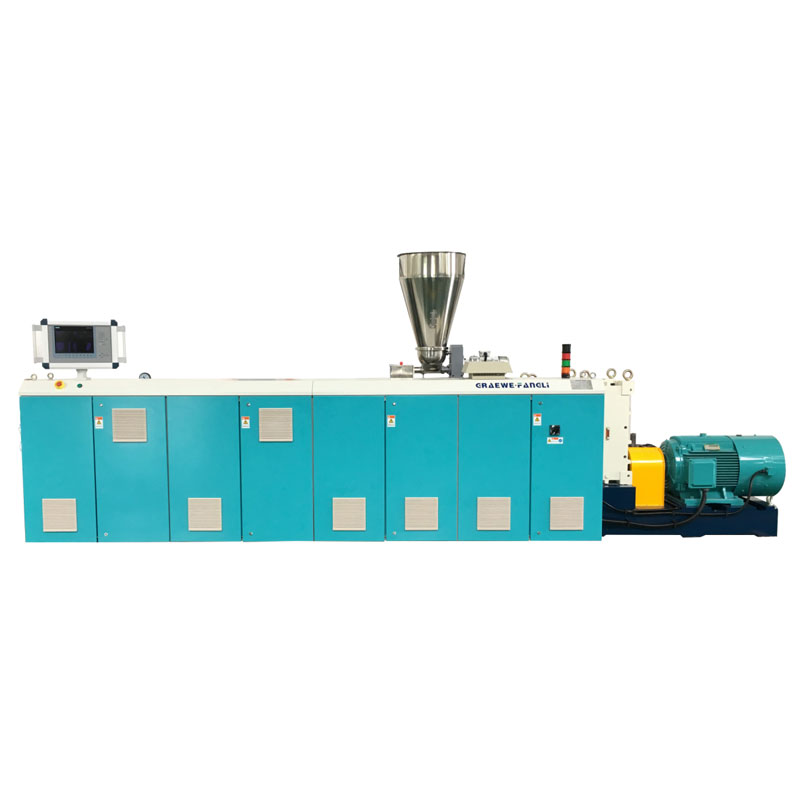
Throughput Baseline: What Do Real Production Lines Achieve?
Based on field data from Fangli installations across Asia and Europe, the following table summarizes typical maximum throughput ranges for UPVC and HDPE pipe extrusion using a Counter-Rotating Parallel Twin Screw Extruder with a 90–110 mm screw diameter:
| Pipe Diameter (mm) | Material | Screw Speed (RPM) | Max Throughput (kg/h) | Melt Temperature (°C) |
|---|---|---|---|---|
| 63–110 | UPVC | 28–35 | 180–220 | 185–195 |
| 160–250 | UPVC | 22–28 | 320–380 | 190–200 |
| 315–450 | UPVC | 18–22 | 480–550 | 195–205 |
| 110–200 | HDPE | 30–40 | 250–300 | 210–220 |
| 250–400 | HDPE | 24–32 | 420–490 | 215–225 |
Note: These values assume a barrel length-to-diameter (L/D) ratio of 28:1, water-cooled vacuum calibration, and standard stabilizer packages.
Five Variables That Cap Your Actual Throughput
Exceeding the numbers above without modifying the system leads to surging, poor fusion, or excessive torque. The Counter-Rotating Parallel Twin Screw Extruder is positive-displacement in nature, but five factors impose hard ceilings:
-
Screw Channel Depth – Deeper channels increase volumetric feed but reduce shear heat; Fangli uses variable-depth metering sections to balance both.
-
Residence Time Distribution – At >40 RPM, residence time drops below 90 seconds, which degrades thermal homogeneity for heat-sensitive PVC.
-
Die Swell Ratio – Higher throughput increases die swell, forcing slower haul-off speeds and reducing net output.
-
Gearbox Torque Limit – Most Counter-Rotating Parallel Twin Screw Extruder gearboxes are rated for 80–90% continuous torque; peak throughput requires operating at 95%, which shortens bearing life.
-
Cooling Capacity – Barrel zone 4 and adapter cooling must remove 40–50 kW of heat; insufficient water flow cuts throughput by 15–20%.
How to Calculate Your Realistic Maximum Throughput
A practical formula used by Fangli process engineers is:
Q_max = (N × V_d × ρ_bulk × η_vol) / (1 + S)
Where:
-
N = screw speed (RPM)
-
V_d = displacement volume per revolution (cm³/rev)
-
ρ_bulk = bulk density of compound (kg/m³)
-
η_vol = volumetric efficiency (0.85–0.92 for counter-rotating)
-
S = slip factor (0.05–0.12, depending on barrel wear)
For a Counter-Rotating Parallel Twin Screw Extruder with 110 mm diameter and V_d = 1,850 cm³/rev, at 25 RPM with PVC bulk density of 620 kg/m³ and η_vol = 0.88, the calculated Q_max is approximately 408 kg/h—which aligns well with the 380–420 kg/h range observed in Fangli factory trials for 250 mm UPVC pipes.
Counter-Rotating Parallel Twin Screw Extruder – FAQ
Q1: Can I increase throughput by simply raising screw speed?
A: No. Above 35 RPM, a Counter-Rotating Parallel Twin Screw Extruder begins to experience incomplete fill in the metering section because the drag flow component decreases relative to pressure flow. The material starts slipping against the barrel wall, causing output to plateau and melt temperature to spike. Fangli recommends a speed window of 18–32 RPM for UPVC and 24–38 RPM for HDPE. If you need higher output, choose a larger diameter model rather than overspeeding.
Q2: Does pelletized feed vs. dry blend affect the maximum throughput?
A: Significantly. Dry blend (with 8–12% volatile content) has lower bulk density (550–620 kg/m³) compared to pelletized compound (720–780 kg/m³). For the same Counter-Rotating Parallel Twin Screw Extruder, dry blend reduces gravimetric feed rate by 18–22% before the hopper bridge forms. Conversely, pelletized feed allows 10–15% higher throughput but requires more shear energy, raising melt temperature by 8–12°C. Fangli supplies dedicated feed-stuffing hoppers with forced feeding to mitigate these differences.
Q3: How does screw wear over time reduce maximum throughput?
A: A worn Counter-Rotating Parallel Twin Screw Extruder loses flight clearance from 0.15 mm (new) to over 0.45 mm after 8,000–10,000 operating hours. This clearance increase raises backflow (leakage flow) from 5% to nearly 18% of total displacement. Consequently, the maximum sustainable throughput drops by 25–30% even at the same RPM. Fangli uses nitrided steel with tungsten-carbide hardfacing on flight tips, extending wear life to 15,000+ hours. We recommend annual clearance measurement and profile regeneration to maintain rated output.
Practical Recommendations for Maximum Sustainable Output
To achieve and sustain the upper limits listed in the table:
-
Use starve-feeding with gravimetric dosing (±0.5% accuracy) to prevent over-torque.
-
Set barrel zone 1 (feed zone) temperature 15°C lower than zone 2 to avoid premature melting and ring formation.
-
Install a melt-pressure transducer before the die and maintain pressure between 180–220 bar—higher pressures reduce throughput due to increased leakage flow.
-
Schedule weekly cleaning of the vacuum vent port; clogged vents reduce degassing and force operators to lower speed by 10–15%.
Fangli offers a digital throughput optimizer that integrates with your Counter-Rotating Parallel Twin Screw Extruder control panel, providing real-time recommendations based on torque, melt pressure, and barrel temperature gradients.
Final Verdict: What Is the Practical Maximum?
For a standard 110 mm Counter-Rotating Parallel Twin Screw Extruder in pipe extrusion, the practical maximum throughput lies between 350–550 kg/h for UPVC and 280–490 kg/h for HDPE, depending on pipe diameter and cooling efficiency. However, the safe continuous maximum—the one that preserves gearbox life and maintains dimensional stability—is typically 10–15% lower than the peak trial value. Always conduct a step-change test: increase feed rate by 5 kg/h every 15 minutes until melt temperature rises 5°C above setpoint or torque reaches 92%; that point defines your real maximum.
Need a Tailored Throughput Assessment for Your Line?
Every pipe extrusion setup has unique screw geometry, resin suppliers, and downstream cooling constraints. Fangli provides on-site or remote throughput audits using our proprietary simulation software—we analyze your screw profile, barrel condition, and thermal profile to pinpoint the exact bottleneck.
Contact us today with your pipe size, material grade, and current screw RPM. Our engineering team will deliver a customized throughput improvement plan within 48 hours, including retrofit options if your Counter-Rotating Parallel Twin Screw Extruder is underperforming.