

What Maintenance Does a Cutting Die Creasing Auto Rule Cutting Machine Require Weekly
2026-06-23
For packaging manufacturers and carton converters, the Cutting Die Creasing Auto Rule Cutting Machine is the heartbeat of the production floor. When this machine stops, so does your output. Yet many operators treat weekly maintenance as an afterthought—until a stripped rule, a misaligned creasing matrix, or a hydraulic leak shuts down an entire shift. At Adewo, we have spent over a decade studying failure patterns across thousands of installations. The data is clear: disciplined weekly maintenance cuts unplanned downtime by over 60% and doubles the service life of critical wear parts. This guide walks through exactly what needs to be checked, cleaned, calibrated, and documented every seven days—not for compliance, but for profitability.
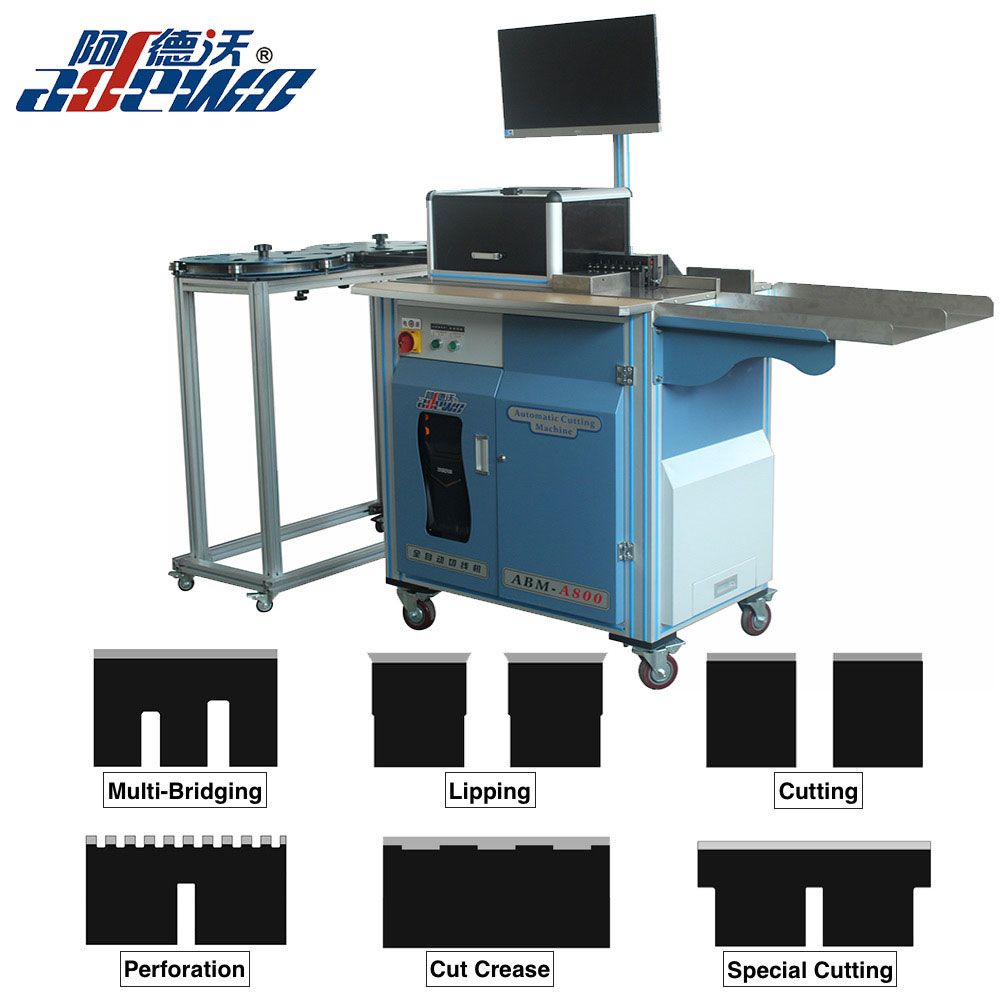
The 7-Day Inspection Routine
Weekly maintenance is not about greasing every fitting. It is about systematic verification of five functional zones. The table below outlines the non-negotiable tasks, their frequency, and the telltale signs that demand immediate action.
| Maintenance Zone | Weekly Task | Warning Sign to Watch | Adewo Recommended Tool |
|---|---|---|---|
| Rule & Cutting Plate | Remove all paper dust; inspect for chipped or bent rules | Uneven cut depth or torn edges on finished blanks | Feeler gauge set (0.05–0.15 mm) |
| Creasing Matrix & Grooves | Clean residues; check matrix alignment with the rule profile | Off-center creases or fibre cracking on the fold line | Laser alignment pointer |
| Feeding & Registration System | Wipe optical sensors; test side-guide precision | Skewed feeding or misregistration beyond ±0.5 mm | Registration test strip (supplied by Adewo) |
| Hydraulic & Pneumatic Circuits | Check oil level; drain moisture from air filters | Slow ram speed or audible hissing from cylinders | Pressure gauge (calibrated to spec) |
| Control Panel & Emergency Stops | Test all E-stop buttons; verify touchscreen response | Delayed reaction or ghost touches on the HMI | Multimeter for continuity checks |
Step-by-Step Weekly Execution
Morning (pre-start): Begin with the creasing zone. Open the safety guard and wipe the lower creasing groove with a lint-free cloth soaked in isopropyl alcohol. Any dried glue or paper fibre trapped here will cause inconsistent crease resistance—a top complaint among folding carton buyers. Next, inspect the auto rule cutting section. Run a finger (gloved) along each rule edge. If you feel a burr or nick, mark that segment for dressing with a fine stone. Adewo machines feature quick-release rule holders, so replacing a damaged rule takes under four minutes without special tools.
Mid-shift (after 3–4 hours of runtime): Stop the Cutting Die Creasing Auto Rule Cutting Machine and measure the blanket or counterplate impression. Use a digital thickness gauge at four corners and centre. A variance greater than 0.08 mm indicates uneven platen pressure—adjust the tie-rods in 1/8-turn increments until balanced. Then purge the air line water separator. Moisture in pneumatic controls is the number one hidden cause of intermittent misfeeds, yet 70% of weekly checklists omit this step.
End-of-day (post-production): Blow out the stripping pins and waste removal chute with compressed air (below 4 bar to avoid damaging sensors). Finally, lubricate the ram guide rails with Adewo-specified high-pressure grease—not standard lithium grease, which degrades under the 200+ tons of cyclical load typical in corrugated die-cutting.
Why Weekly Discipline Directly Affects Your Bottom Line
A neglected creasing matrix costs you 2–3% more in board waste per thousand sheets. A dull rule increases cutting force demand, straining the hydraulic pump and spiking energy consumption by up to 15%. Over 52 weeks, that waste equals the price of a brand-new rule set. More critically, erratic creasing leads to customer returns—and in food packaging, a single rejected batch can ruin a long-term contract. Adewo designs its auto rule cutting systems with modular wear parts, so weekly inspections are not repair work; they are data-collection opportunities. Logging impression pressures, rule temperatures, and sensor counts helps predict failures two weeks before they occur—a capability that transforms maintenance from a cost centre into a competitive advantage.
Cutting Die Creasing Auto Rule Cutting Machine – FAQ
Q1: How do I know if the creasing matrix needs replacement before the weekly inspection is due?
A1: Run a blind test with five sample sheets at the start of every production lot. Fold each blank 180° backwards. If the crease shows a white tensile line (fibre rupture) on the coated side, or if the fold resistance feels inconsistent from one sheet to the next, the matrix groove has worn beyond tolerance—typically when the groove width has increased by 0.2 mm from its original spec. Adewo recommends keeping a spare creasing cassette on hand and swapping it immediately upon detecting this symptom, rather than waiting for the scheduled weekly check. Delaying replacement will accelerate rule wear and can permanently deform the counterplate, a repair costing upwards of USD 1,200.
Q2: Can I use generic cleaning solvents on the feed rollers and optical sensors of the Cutting Die Creasing Auto Rule Cutting Machine?
A2: No. Optical registration sensors rely on anti-glare coatings that are soluble in acetone, toluene, or aggressive degreasers. Use only isopropyl alcohol (70% concentration maximum) on a microfiber cloth for sensor lenses. For feed rollers, Adewo explicitly forbids silicone-based sprays because they transfer to the board surface and compromise glue adhesion in later converting steps. Instead, use a water-based roller cleaner that leaves no residue. If the rollers feel slick, clean them with a mild pumice hand-cleaner (non-solvent) and rinse with distilled water. Weekly cleaning should remove visible ink or dust buildup, but never over-wipe—excessive friction wears the roller’s micro-texture, reducing its grip on lightweight papers.
Q3: What is the single most critical parameter to record during weekly maintenance, and why?
A3: The dwell time—the milliseconds the platen remains closed at bottom dead centre. A Cutting Die Creasing Auto Rule Cutting Machine loses hydraulic seal efficiency gradually, and dwell time shifts from the factory setting (typically 80–120 ms) toward shorter or longer values. If dwell time shortens by more than 15 ms, the cutting pressure drops before full penetration, causing hanging chads. If it lengthens, the crease becomes over-compressed and brittle. Record dwell time every Friday afternoon using the HMI’s diagnostics menu and compare it to the baseline logged during Adewo’s commissioning. A steady drift of 2–3 ms per week indicates normal seal bedding; a jump of 10 ms in a single week signals a failing check valve that should be replaced immediately—a 20-minute job that prevents a catastrophic pump failure.
The Hidden Cost of Skipping One Week
Production managers often think, “We ran 100,000 sheets last week without a glitch—we can skip this Friday’s checks.” That is precisely when a microscopic crack in the rule holder propagates, a sensor lens fogs from ambient humidity, or a creasing matrix shifts 0.3 mm due to thermal expansion. By Monday morning, the first pallet of cartons runs 2% out of spec—but nobody notices until the customer’s quality lab rejects the entire shipment at the dock. That one skipped weekly maintenance costs, on average, USD 4,700 in rework, freight, and lost goodwill. Adewo provides a laminated weekly checklist with every Cutting Die Creasing Auto Rule Cutting Machine; using it consistently turns maintenance from a chore into a documented proof of due diligence—essential for ISO 9001 audits and customer scorecards alike.
Beyond Weekly – Building a Predictive Culture
Weekly tasks are the foundation, but they are most powerful when paired with trend analysis. Record the five measurements from the table above into a simple logbook (or Adewo’s optional cloud dashboard). Over 8–10 weeks, patterns emerge: a rule that requires dressing every third week may indicate an off-level platen; a creasing groove that wears faster on the operator side suggests uneven feed pressure. Correcting these root causes reduces weekly workload over time. Many Adewo users report that after three months of disciplined weekly maintenance, their Friday checklist time drops from 90 minutes to under 45 minutes—because proactive corrections eliminate the reactive firefighting that used to consume Monday mornings.
Your Machine Deserves More Than a Grease Gun
Weekly maintenance is not about ticking boxes. It is about respecting the engineering precision built into every Cutting Die Creasing Auto Rule Cutting Machine. When you inspect with intent, record with accuracy, and act with urgency, you transform a routine chore into a strategic lever for quality, cost, and delivery performance. Adewo machines are engineered for 20,000+ operating hours, but that longevity depends entirely on the operator’s weekly discipline. The next seven days are your opportunity to prove it.
Ready to optimize your weekly maintenance protocol? Contact the Adewo service team today for a complimentary one-on-one session—we will review your current checklist, recommend spare parts inventory levels, and even send a field engineer to conduct a hands-on walkthrough at your facility. Reach out via our website or call your regional Adewo representative—because a well-maintained machine is the quietest investment you will ever make. Let us keep your production running, shift after shift.