

What Makes Blow Molding Machines the Core Equipment for Plastic Packaging Industries?
2026-09-04
Think about the plastic containers in your daily life—water bottles, shampoo bottles, milk jugs, detergent containers. They are all produced using blow molding. But the specific process—extrusion blow molding, injection blow molding, or stretch blow molding—depends on the container type, the production volume, and the quality requirements. The Blow Molding Machine is not a single category of equipment; it is a family of technologies. Choosing the right process and the right machine configuration determines whether your packaging line runs at 95 percent efficiency or 65 percent efficiency. This guide is written for production managers who need to understand the technical and economic differences between blow molding technologies.
1. Why Does Container Shape and Volume Dictate the Blow Molding Process?
The first step in selecting a Blow Molding Machine is to understand the relationship between container geometry and the forming process. Simple, symmetrical containers like bottles and jars can be produced efficiently with extrusion blow molding (EBM). Containers with complex handle designs or multi-layer structures require injection blow molding (IBM) or injection stretch blow molding (ISBM). The table below shows the recommended process for different container types.
| Container type | Typical volume range | Recommended blow molding process | Why this process |
| Beverage bottles (PET) | 250 ml – 2 L | Injection stretch blow molding (ISBM) | High clarity, consistent wall thickness, lightweight |
| Milk jugs, detergent bottles (HDPE) | 500 ml – 5 L | Extrusion blow molding (EBM) | Low cost, high output, suitable for opaque containers |
| Pharmaceutical bottles (precise neck) | 10 ml – 500 ml | Injection blow molding (IBM) | Precise neck finish, no flash, clean process |
| Industrial drums, jerrycans | 5 L – 30 L | Extrusion blow molding (large EBM) | High wall thickness, handling requirements, large parison |
| Multilayer food containers (barrier layers) | 200 ml – 1 L | Co-extrusion blow molding (EBM with multiple extruders) | Requires layers of EVOH or Nylon for oxygen barrier |
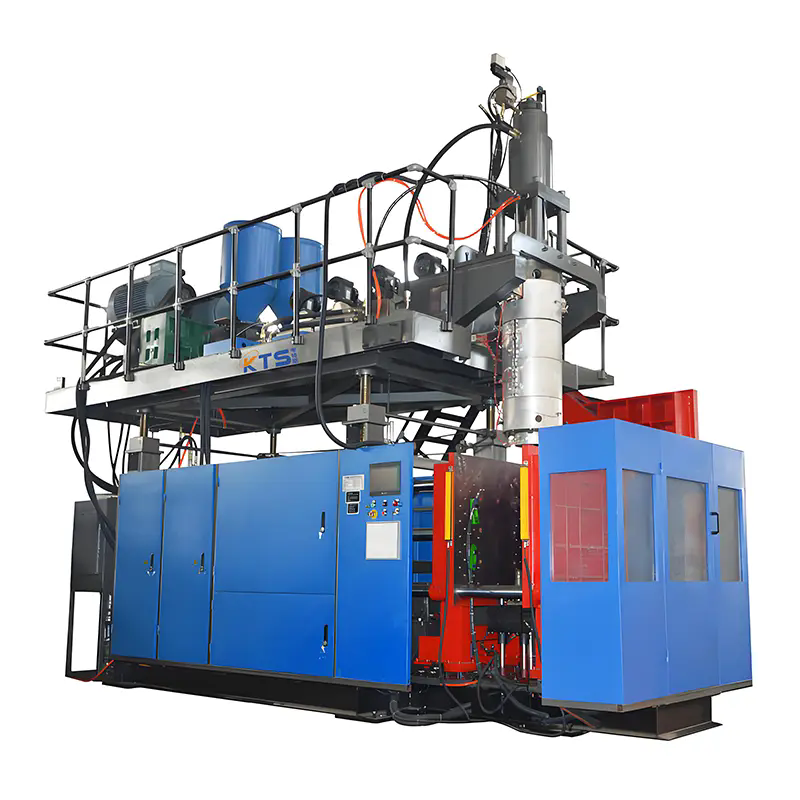
At Ningbo Kaotesi Machinery Manufacturing Co., Ltd., we manufacture Blow Molding Machine units for all three processes. Our factory has a dedicated R&D team that advises customers on the optimal process for their product portfolio. This is the first step in achieving a production line that runs efficiently.
2. How Does Machine Configuration Affect Production Efficiency and Scrap Rate?
The efficiency of a Blow Molding Machine is determined by three key parameters: cycle time, shot weight, and flash (scrap) percentage. Cycle time is the total time from parison extrusion to finished container. Shot weight is the total weight of plastic used per cycle. Flash is the amount of excess plastic that must be trimmed and reground. A poorly tuned machine can have a scrap rate of 30 percent. A well-tuned machine can reduce scrap to 10 to 15 percent. The table below shows the production parameters for three typical Blow Molding Machine configurations in our factory.
| Machine model | Process type | Typical cycle time (seconds) | Typical shot weight (grams) | Flash percentage | Output per hour (bottles) |
| KTM-EB-45 (1.0L bottle) | Extrusion blow (EBM) | 4.0 | 65 | 18% | 900 |
| KTM-IB-25 (100ml bottle) | Injection blow (IBM) | 6.5 | 22 | 8% | 550 |
| KTM-ISB-30 (1.0L PET) | Injection stretch (ISBM) | 5.0 | 50 | 12% | 720 |
In our factory, we test every Blow Molding Machine at full production speed before it is shipped. We provide a production report that shows the actual output, scrap percentage, and energy consumption of the machine at your specified operating conditions.
3. What Is the Real Impact of Energy Efficiency on Production Cost?
Plastic packaging is an energy-intensive industry. A Blow Molding Machine typically uses 40 to 60 kW of electricity per hour for heating the barrel, driving the extruder, and operating the hydraulic system. Over an 8,000-hour year, this is 320,000 to 480,000 kWh. At $0.12 per kWh, the annual electricity cost is $38,000 to $58,000. A machine with a 5 percent higher energy efficiency can save $2,000 to $3,000 per year. This may seem small, but in a plant with 10 machines, it becomes $20,000 to $30,000 per year.
Energy saving calculation: A Blow Molding Machine with a variable frequency drive on the extruder motor reduces energy consumption by 15 percent during the heating phase. For a machine that draws 50 kW at full load, the average consumption drops to 42.5 kW. Annual saving: 7.5 kW × 8,000 hours × $0.12 = $7,200 per machine. Over 5 machines, the saving is $36,000 per year.
In our factory, we equip all Blow Molding Machine units with servo motors and variable frequency drives as standard. This reduces energy consumption by 12 to 18 percent compared to fixed speed motors. We also provide a 3-year energy consumption guarantee that covers the difference between our claimed consumption and actual consumption.
4. How Does Mold Design and Changeover Time Affect Production Flexibility?
In a packaging plant, changeover time is the enemy of productivity. Each time you switch from one container size or shape to another, the machine is idle. A Blow Molding Machine with a quick-change mold system can reduce changeover time from 4 hours to 45 minutes. This means you can run smaller batches economically, which allows you to respond to customer orders faster. In our factory, we use a mold clamping system that can be locked and unlocked with a single lever. The mold mounting plate is pre-aligned with dowel pins, so the mold is always in the correct position. We also offer a mold pre-heating system that keeps the mold at operating temperature during the changeover, eliminating the 30-minute warm-up period. Over a year with 50 changeovers, a quick-change system saves 150 hours of downtime, which adds $15,000 to $25,000 of additional production capacity.
Frequently Asked Questions About Blow Molding Machine Selection
Summary for Production Managers
The selection of a Blow Molding Machine is not a one-size-fits-all decision. The process type must match the container geometry and the material. The machine configuration must be optimized for throughput, scrap rate, and energy consumption. The mold design must support rapid changeovers. And the machine must be compatible with the resin grades you plan to use. The technical and economic differences between machine types are significant, and the right choice will determine the long-term profitability of your packaging line.
Ningbo Kaotesi Machinery Manufacturing Co., Ltd. manufactures Blow Molding Machine units for all three processes: extrusion blow, injection blow, and injection stretch blow. We provide a complete production line consultation, including process selection, machine sizing, and mold design support. Each machine is tested under full production conditions before shipment.