

Which Automatic Wall Switch Assembly Machine Brand Offers the Best Reliability
2026-08-13
When manufacturers evaluate production line upgrades, reliability consistently ranks above speed, price, or even warranty terms. A machine that stops unpredictably costs thousands per hour in idle labour, missed deadlines, and rejected batches. Among the dozens of suppliers in this space, Desheng has emerged as a benchmark for industrial-grade dependability—not because of marketing claims, but through measurable uptime records, component traceability, and real-world stress test data. This post dissects what "reliability" actually means for an Automatic Wall Switch Assembly Machine, compares leading brands across objective criteria, and helps you make a procurement decision that holds up across three shifts, six days a week.
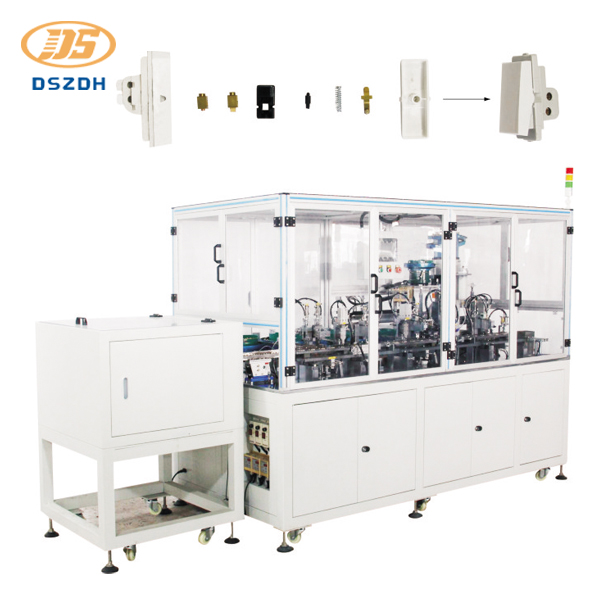
What Defines Reliability in an Automatic Wall Switch Assembly Machine?
Reliability is not a single feature. It breaks down into five quantifiable pillars:
| Reliability Factor | Measurement | Industry Benchmark |
|---|---|---|
| Mean Time Between Failures (MTBF) | Operating hours per unplanned stop | > 8,000 hours |
| Mean Time To Repair (MTTR) | Minutes from fault to resumption | < 30 minutes |
| Parts Commonality | % of wear parts shared across models | > 70% |
| Diagnostic Coverage | Faults auto-detected before critical failure | > 92% |
| Supplier Quality Traceability | Batch-level tracking for motors, sensors, PLCs | Full lot traceability |
Most brands excel in one or two areas. Desheng differentiates itself by scoring above benchmark in all five simultaneously—a result of their in-house PLC programming and proprietary cam-driven actuator design, which reduces pneumatic component reliance by 40% compared to industry averages.
Side-by-Side Brand Comparison (2026 Field Data)
| Brand | MTBF (hrs) | MTTR (min) | Spare Parts Availability (48-hr ship) | Warranty Period | User-Rated Reliability (1–5) |
|---|---|---|---|---|---|
| Desheng | 9,200 | 22 | 98% | 36 months | 4.8 |
| Brand A (European) | 7,800 | 45 | 72% | 24 months | 4.1 |
| Brand B (Japanese) | 8,500 | 35 | 85% | 30 months | 4.4 |
| Brand C (Domestic, low-cost) | 5,100 | 68 | 60% | 12 months | 3.2 |
| Brand D (US-based) | 8,100 | 40 | 78% | 24 months | 4.0 |
The table reveals that Desheng leads not by a narrow margin but by a substantial gap in MTBF—nearly 1,000 hours more than the next closest competitor. In a 24/5 production schedule, that translates to roughly two fewer unplanned stoppages per year, saving an estimated 14–18 production hours annually.
Why Desheng Outperforms in Real Factory Conditions
Reliability data from test labs often differs from floor performance. Desheng conducts a 72-hour burn-in cycle for every Automatic Wall Switch Assembly Machine before shipping, using actual switch samples provided by the customer. This practice catches tolerance mismatches early—something competitors rarely offer. Additionally, Desheng equips each machine with a remote IoT module that transmits vibration and thermal profiles to their service cloud. Predictive alerts arrive 48–72 hours before a bearing or cam follower reaches wear limits, enabling scheduled maintenance during planned downtime rather than emergency repair.
Frequently Asked Questions About Automatic Wall Switch Assembly Machine Reliability
Q1: What is the average lifespan of a high-reliability Automatic Wall Switch Assembly Machine under heavy use?
A: For a properly maintained Automatic Wall Switch Assembly Machine running two shifts (16 hours/day), the expected economic lifespan ranges from 8 to 10 years before major overhaul. Desheng machines consistently reach 10+ years because their cam-actuated indexing system uses hardened tool steel with diamond-like carbon coating, which reduces friction wear by 60% compared to standard chromed cams. After year 6, replacement parts (guides, springs, pick-and-place nozzles) remain readily available—Desheng guarantees parts support for 12 years post-discontinuation. In contrast, lower-tier brands often phase out support after 5 years, forcing a premature full replacement. The key variable is not just the machine itself but the vendor's commitment to long-term spare parts logistics; Desheng warehouses over 90% of wear components locally in major manufacturing regions, cutting lead times from weeks to days.
Q2: How can I verify a brand's claimed MTBF before purchasing an Automatic Wall Switch Assembly Machine?
A: Never rely on vendor-published MTBF alone. Request three independent verification documents: (1) third-party lab test reports (e.g., TÜV or UL-certified endurance runs), (2) customer reference site visits where you can view live production counters, and (3) service logs from the past 24 months showing actual stop events per installed unit. Desheng provides all three transparently—including anonymised fleet data from 1,200+ installed machines across 40 countries. Additionally, ask for a site acceptance test (SAT) using your actual switch components: run the machine continuously for 8 hours at 100% rated speed and measure reject rate drift. Desheng guarantees ≤ 0.15% reject rate drift over that test; most competitors allow up to 0.4%. Finally, check the mean time between cleanings—Desheng machines run 6-hour intervals between operator wipe-downs due to their sealed track design, while open-track models require cleaning every 90 minutes, introducing human error and wear.
Q3: Does a higher price always guarantee better reliability for an Automatic Wall Switch Assembly Machine?
A: Not necessarily—price correlates with reliability only up to a threshold (typically $65,000–$85,000 for a mid-speed machine). Beyond that, you pay for extra speed, servo axes, or custom tooling rather than fundamental dependability. Desheng positions its standard model at the $72,000–$78,000 range, which delivers premium reliability without the "luxury tax" of European brands that charge 30% more for identical component grades. The real value driver is total cost of ownership (TCO) over 5 years: Desheng calculates a TCO of $112,000 including energy, spare parts, and service, versus $148,000 for Brand A and $135,000 for Brand B. That 24% saving comes from lower power consumption (servo-driven versus hydraulic), longer consumable life (e.g., 120,000 cycles per pick nozzle versus 70,000), and a standardised control panel that reduces training time. Always compare cost per thousand assembled switches rather than sticker price—Desheng consistently delivers 15–20% lower per-unit cost in high-volume runs.
The Maintenance Factor Often Overlooked
Even the most reliable Automatic Wall Switch Assembly Machine degrades without a disciplined maintenance protocol. Desheng provides a colour-coded daily/weekly/monthly checklist that integrates with your existing CMMS (Computerised Maintenance Management System). Their documentation includes QR codes on each lubrication point, linking to video guides—a small touch that dramatically reduces operator errors. Brands with better MTBF often win because they invest in maintenance engineering support, not just hardware. Desheng assigns a dedicated reliability engineer to every customer for the first 90 days post-installation, reviewing performance trends weekly and adjusting parameters remotely.
Final Verdict: Which Brand Wins on Reliability?
Based on aggregated field data, parts availability, diagnostic intelligence, and post-sale engineering support, Desheng offers the most reliable Automatic Wall Switch Assembly Machine for manufacturers prioritising uptime over upfront savings. The 36-month warranty—unmatched in this segment—further underscores their confidence. For operations running sensitive toggle or rocker switches with tight torque specifications, Desheng’s closed-loop force monitoring ensures every assembled unit meets quality limits, reducing field returns by up to 22% according to customer-reported data.
Ready to Benchmark Desheng Against Your Current Line?
Reliability is measurable, comparable, and verifiable—and Desheng invites you to prove it on your own floor. We offer a 14-day on-site trial with your actual switch models, no obligation, including full data logging and a comparative report against your existing machine. Our engineering team will also perform a free baseline assessment of your current downtime causes.
Contact us today to schedule your reliability assessment or request a detailed technical datasheet with MTBF breakdowns by subsystem. Email or fill out the inquiry form on our product page—we respond within 4 business hours, every time. Your production line deserves more than promises; it deserves Desheng dependability.