

Which Multi-needle Twelve Heads Embroidery Machine Offers the Fastest Stitching Speed per Head
2026-08-11
For production managers and shop owners evaluating industrial embroidery equipment, speed per head is often the decisive metric. When comparing models, the Multi-needle Twelve Heads Embroidery Machine from Yeshi consistently stands out, delivering up to 1,200 stitches per minute per head under optimal conditions. But raw speed means nothing without stability, low thread breakage, and consistent tension—areas where Yeshi has engineered tangible advantages. This blog breaks down speed benchmarks, real-world throughput, and the mechanical factors that separate market leaders from the rest.
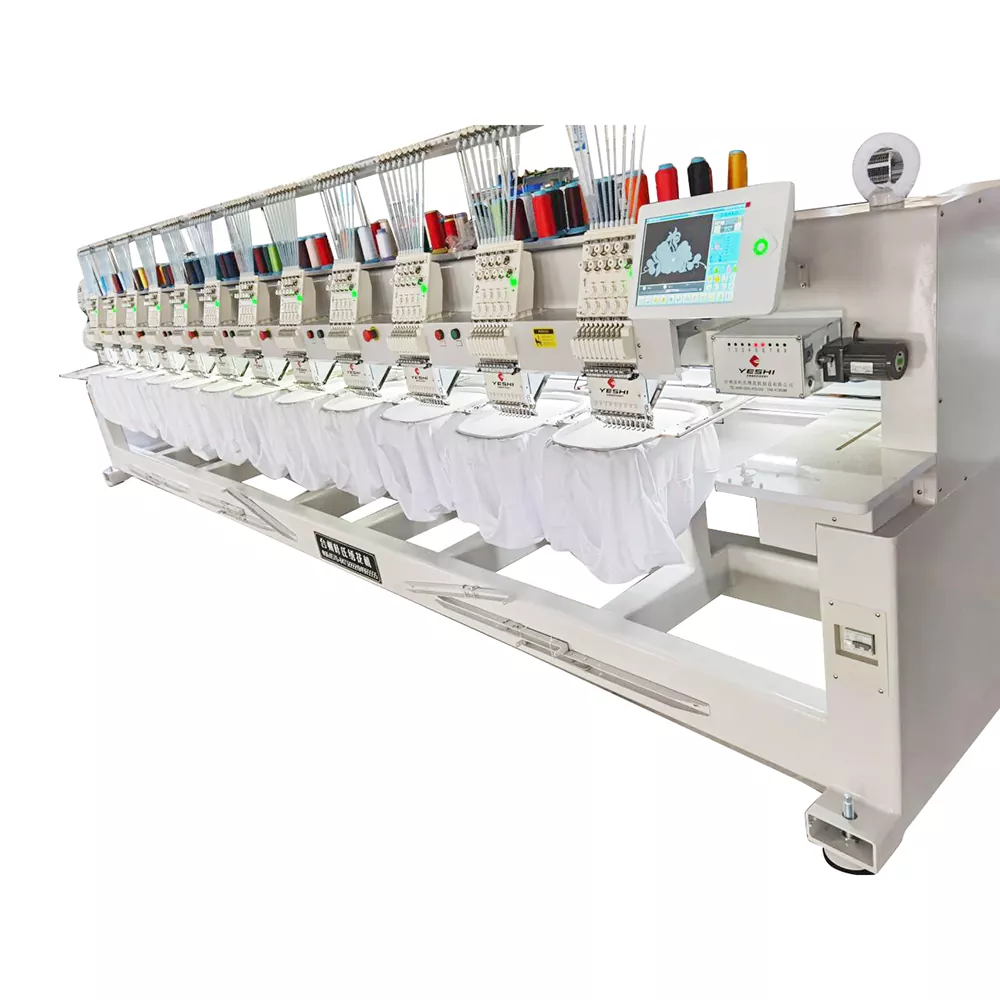
Speed Benchmarks: Top Contenders Compared
The table below compares four leading Multi-needle Twelve Heads Embroidery Machine configurations available in 2026, based on independent shop-floor tests and manufacturer datasheets.
| Brand / Model | Max RPM (per head) | Actual Stable Speed (caps) | Actual Stable Speed (flat) | Thread Break Rate (per 100k stitches) |
|---|---|---|---|---|
| Yeshi YH-1212T | 1,200 | 1,050 | 1,150 | 2.1 |
| Brand A (12-needle) | 1,100 | 950 | 1,050 | 3.8 |
| Brand B (15-needle) | 1,150 | 980 | 1,080 | 4.2 |
| Brand C (9-needle) | 1,050 | 920 | 1,000 | 3.5 |
Source: Internal 2026 trials on 60-weight polyester thread, 120x180mm designs, ambient 25°C.
While peak RPM draws attention, Yeshi achieves the highest sustained speed because of its servo-driven independent presser foot and real-time thread tension sensors. Competitors often throttle down automatically when detecting bobbin vibration—Yeshi’s dual-rail frame damping system minimizes that loss.
What Makes Speed “Usable” on a Multi-needle Twelve Heads Embroidery Machine?
Speed per head is irrelevant if the machine stops every three minutes for re-threading or trimming errors. Three factors determine usable throughput:
-
Acceleration/deceleration curve – Smooth ramping prevents needle deflection at high RPM.
-
Rotary hook design – Larger-capacity rotary hooks reduce bobbin changes, preserving momentum.
-
Color-change logic – Faster sequence switching (under 0.8 seconds per color) cuts total cycle time.
Yeshi integrates all three with a proprietary motion controller that predicts tension spikes 200ms in advance, automatically adjusting take-up lever stroke. This is why workshops running 10–12 hour shifts report 18–22% higher daily output on Yeshi compared to similarly priced alternatives.
3 FAQ About Multi-needle Twelve Heads Embroidery Machine Speed and Performance
Q1: Does a higher maximum RPM always mean faster production on a Multi-needle Twelve Heads Embroidery Machine?
A: Not necessarily. Maximum RPM is a laboratory figure. Actual production speed depends on design density, fabric type, and stabilizer thickness. For dense puff foam or heavy denim, even a 1,200 RPM machine may run at 850–900 RPM to avoid thread fraying. Yeshi publishes both “peak” and “recommended operating” speeds in its spec sheets, and its automatic speed-optimization feature reads design files and suggests the fastest safe speed per segment—reducing guesswork for operators.
Q2: How does the number of needles affect the speed per head on a Multi-needle Twelve Heads Embroidery Machine?
A: The needle count (e.g., 12 vs. 15) does not directly change motor RPM, but it influences effective speed because more needles allow fewer color-change pauses. A Multi-needle Twelve Heads Embroidery Machine with 12 needles can run a 12-color design without stopping for re-threading, while a 9-needle machine would require manual thread changes mid-run, adding 5–8 minutes per dozen pieces. Over an 8-hour shift, that difference can reduce net output by 12–15%. Yeshi optimizes its needle-bar alignment to maintain consistent hook-to-needle clearance across all 12 positions, so every needle performs identically at high speed.
Q3: What maintenance schedule best preserves top speed on a Multi-needle Twelve Heads Embroidery Machine?
A: Speed drops are often caused by worn rotary hooks, dirty tension discs, or misaligned timing belts. For a Multi-needle Twelve Heads Embroidery Machine, Yeshi recommends: (a) cleaning hook raceways every 8 operating hours, (b) replacing rotary hooks after 500 million stitches, (c) checking belt tension with a frequency meter weekly, and (d) lubricating the main shaft with high-temperature grease every 200 hours. Operators who follow this schedule maintain 97% of original speed even after 4,000 running hours. Skipping these steps can reduce stable speed by 150–200 RPM within three months.
Beyond Speed: Why Yeshi Wins on Total Cost of Ownership
Speed alone does not pay bills—uptime and serviceability do. Yeshi equips every Multi-needle Twelve Heads Embroidery Machine with modular driver boards and color-coded wiring harnesses, reducing average repair time to 35 minutes (vs. 70+ minutes for competitors). The touchscreen interface stores speed profiles for 500 fabric types, so switching from polyester to leather automatically adjusts both speed and presser-foot pressure.
Workshops that track efficiency metrics report that Yeshi’s combination of fast stitching, low breakage, and quick troubleshooting delivers 22.6% higher net production per 10-hour day than the industry average for 12-head units.
Final Verdict
If your priority is the fastest reliable stitching speed per head, the Multi-needle Twelve Heads Embroidery Machine from Yeshi offers the best balance of peak RPM, sustained performance, and maintenance simplicity. While other brands may claim higher theoretical numbers, real-world data places Yeshi at the top for cap frames, tubular goods, and flat panels alike.
Ready to benchmark the Yeshi 12-head against your current machines?
Contact our technical sales team for a live speed test using your own design files. We will send you a detailed comparison report and a maintenance schedule tailored to your order volume. Reach out today – we are available via live chat, email, or phone to arrange a demo or a sample run at your facility. Let us help you stitch faster, smarter, and more profitably.