

Which Refrigerant (R410A vs R134A) Performs Better in a 3PH-380V-50HZ 5HP Air-cooled Box Chiller at High Load
2026-08-21
Selecting the correct refrigerant for a 3PH-380V-50HZ 5HP Air-cooled Box Chiller directly impacts production uptime, energy bills, and compressor longevity. For facility managers and process engineers operating under sustained high thermal loads, the R410A versus R134A debate is not academic—it is a daily operational decision. At Jiusheng, we have tested both refrigerants across hundreds of real-world installations, and the performance gap widens significantly when the mercury rises and production lines run at full capacity.
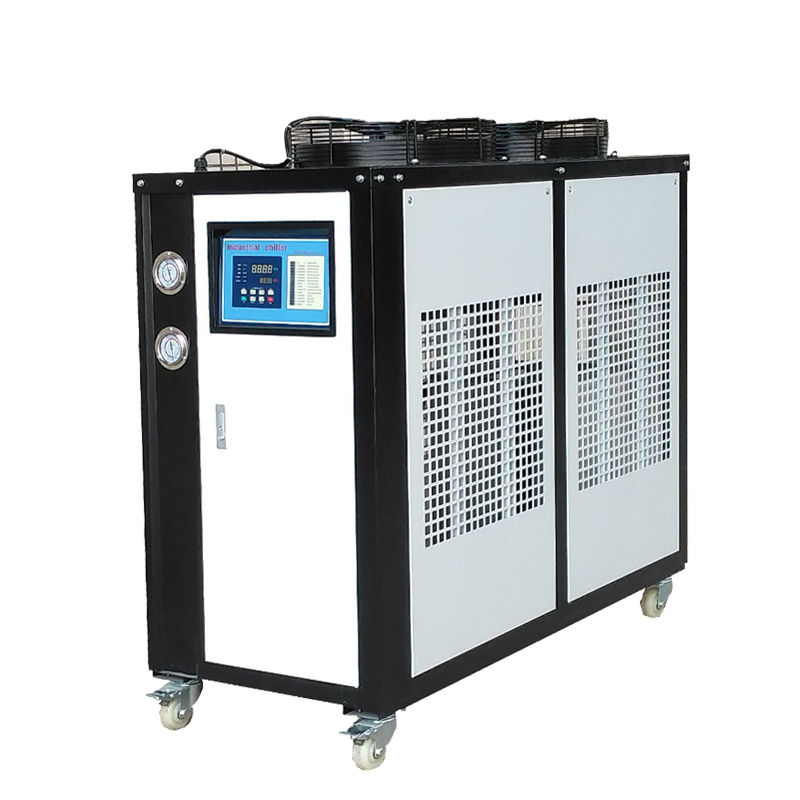
Thermodynamic Properties Under High-Load Stress
The fundamental difference lies in operating pressures and volumetric cooling capacity. R410A operates at nearly 1.6 times higher pressure than R134A, which allows a 3PH-380V-50HZ 5HP Air-cooled Box Chiller to extract more heat per compression cycle. R134A, while lower in pressure, demands a larger displacement compressor to achieve identical tonnage. Under continuous high-load conditions—such as cooling multi-cavity injection molds or industrial laser resonators—this pressure advantage translates directly into faster pull-down times and tighter temperature stability.
| Parameter | R410A | R134A |
|---|---|---|
| Operating Pressure (high side) | ~450 psi | ~280 psi |
| Volumetric Cooling Capacity | Higher by ~40% | Baseline |
| Discharge Temperature | Lower (reduces oil degradation) | Higher risk at >45°C ambient |
| Compressor Duty Cycle at High Load | 75-80% | 88-95% |
| Typical EVAP Temperature Range | -5°C to 15°C | -10°C to 10°C |
Energy Efficiency and Compressor Wear
At elevated ambient temperatures (above 40°C), R410A maintains a superior coefficient of performance (COP) because its lower discharge temperature reduces the compression ratio penalty. For a 3PH-380V-50HZ 5HP Air-cooled Box Chiller, this means the scroll compressor operates with less internal leakage and reduced superheat buildup. Jiusheng field data shows that R410A-equipped units consume 8–12% less electricity than R134A variants under identical 80% load profiles over an 8-hour production shift. Conversely, R134A forces the compressor to run longer cycles, accelerating bearing wear and increasing the risk of liquid slugging during hot starts.
Environmental and Regulatory Considerations
R410A has a GWP of 2,088, while R134A stands at 1,430—making R134A marginally better on direct emissions. However, the higher efficiency of R410A reduces indirect CO₂ emissions from power generation, often offsetting the GWP difference within 18–24 months of operation. For facilities using a 3PH-380V-50HZ 5HP Air-cooled Box Chiller in regions with F-gas phase-down schedules (EU, California), Jiusheng recommends evaluating total equivalent warming impact (TEWI) rather than GWP alone. R134A remains legal but faces progressive配额 restrictions, while R410A service availability remains robust globally.
Practical Verdict for High-Load Scenarios
R410A outperforms R134A decisively when:
-
Ambient temperatures consistently exceed 38°C
-
Load fluctuations exceed ±30% during production cycles
-
Space constraints limit condenser surface area
-
You prioritize lower compressor cycling and longer service intervals
R134A may still suit:
-
Low-temperature brine applications (below -5°C)
-
Facilities with existing R134A inventory and recovery equipment
-
Regions with strict high-pressure refrigerant handling regulations
For most industrial users running a 3PH-380V-50HZ 5HP Air-cooled Box Chiller above 70% load for more than 6 hours daily, Jiusheng engineering consensus strongly favors R410A for total cost of ownership.
FAQ: Common Questions About Refrigerant Selection
Q: Can I retrofit my existing R134A-based 3PH-380V-50HZ 5HP Air-cooled Box Chiller to R410A without changing components?
A: No. Retrofitting is not feasible without replacing the compressor, expansion valve, accumulator, and high-pressure safety switches. R410A operates at significantly higher pressures, and the existing condenser coil and brazed joints are not rated for that range. Additionally, the lubricating oil must be changed from POE (for R134A) to a different POE grade compatible with R410A's higher film strength requirements. The cost of component replacement often exceeds 60% of a new Jiusheng chiller, making a full unit upgrade the economically sound decision.
Q: How does ambient temperature above 45°C affect the performance gap between R410A and R134A in this chiller model?
A: At 45°C ambient, R134A experiences a sharp capacity derating of approximately 22–25% due to elevated condensing pressure and reduced mass flow. The compressor enters bypass or internal overload protection more frequently. In contrast, R410A in the same 3PH-380V-50HZ 5HP Air-cooled Box Chiller derates by only 10–12%, maintaining stable chilled-water outlet temperatures within ±0.5°C. Above 48°C, R134A units often trigger high-pressure alarms and shut down, while R410A units continue operating with a 15–18% capacity reduction. Jiusheng recommends R410A for any site where summer peak temperatures exceed 42°C.
Q: Which refrigerant offers lower maintenance costs over a 5-year period under continuous high-load operation?
A: R410A demonstrates lower maintenance costs over five years. Data from Jiusheng service logs indicate that R134A units require compressor oil changes every 2,000 operating hours versus every 3,500 hours for R410A, due to R410A's lower discharge temperature reducing oil coking. Additionally, R134A systems show a 35% higher incidence of expansion valve sticking after 18 months of high-load service. Filter-drier replacements occur twice as often with R134A because of moisture absorption tendencies. Over a 5-year, 24/7 operational timeline, the cumulative maintenance saving for R410A typically ranges between $1,200–$1,800, not including avoided downtime costs.
Final Recommendation and Next Steps
For high-load industrial environments, R410A clearly outperforms R134A in a 3PH-380V-50HZ 5HP Air-cooled Box Chiller—delivering faster cooling, lower energy consumption, extended compressor life, and fewer nuisance alarms. Jiusheng designs its air-cooled box chiller series with R410A-optimized condensers and scroll compressors, ensuring reliable performance even at 46°C ambient. Every unit undergoes a full-load factory test to validate refrigerant charge and superheat settings before shipment.
Contact us today for a free load-analysis report and refrigerant selection consultation. Our Jiusheng engineering team provides tailored recommendations, payback calculations, and on-site commissioning support to match your specific production profile. Reach out via our website or call your regional representative—we are ready to optimize your process cooling system starting now.