

Why Do Advanced T Beam Welding Lines Drive Higher Efficiency, Precision?
2025-12-03
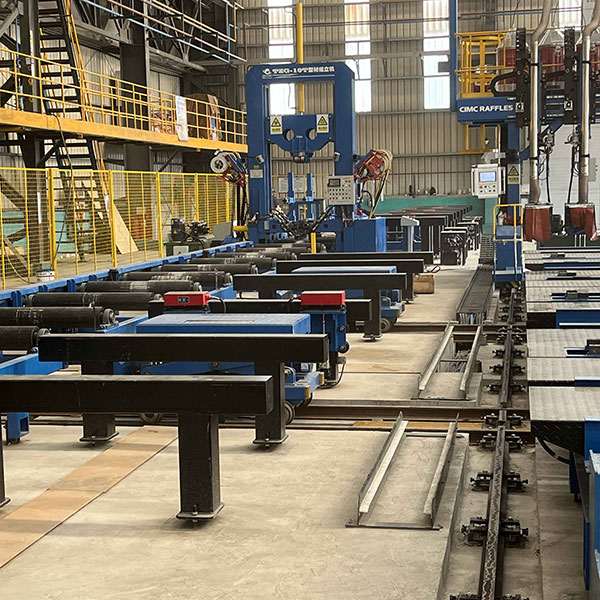
T Beam Welding Lines are automated production systems designed to fabricate T-shaped structural beams used in bridges, shipbuilding, high-rise buildings, offshore platforms, and industrial machinery. By integrating cutting, positioning, submerged arc welding (SAW), straightening, and quality-control mechanisms into a single streamlined line, these systems significantly enhance manufacturing productivity while ensuring consistent welding quality.
How Do T Beam Welding Lines Achieve High-Precision Beam Fabrication?
T Beam Welding Lines rely on synchronized automation technology that manages every stage of beam fabrication—material input, flange positioning, web assembly, welding, straightening, and final inspection. Unlike manual welding or semi-automatic equipment, an integrated line allows continuous, uninterrupted production.
Structural Workflow of a T Beam Welding Line
-
Web and flange feeding – Materials enter the line through motorized conveyors.
-
Automatic assembly – Hydraulic positioning centers align the web and flange with millimeter-level accuracy.
-
Tack welding – Initial welds secure components for stable SAW welding.
-
Submerged Arc Welding (SAW) – Deep-penetration welds create strong beam joints.
-
Integrated straightening – Rollers and hydraulic presses correct deformation caused by heat.
-
Discharging and inspection – The welded T beam is output for quality verification.
Technical Parameters of Advanced T Beam Welding Lines
Below is a professional parameter table for reference:
| Parameter | Specification Range |
|---|---|
| Web Height | 200–2000 mm |
| Flange Width | 200–800 mm |
| Beam Length | 6–15 m |
| Welding Method | SAW (Single or Double Wire) |
| Welding Speed | 0.2–2.0 m/min |
| Assembly Tolerance | ±1 mm |
| Straightening Capacity | 20–40 mm camber correction |
| Line Control System | PLC + HMI touch-screen interface |
| Conveyor Load Capacity | 10–20 tons |
| Welding Power Supply | 1000–1500 A |
These specifications may vary according to factory output requirements and production volume.
How Automation Improves Welding Accuracy
-
Real-time alignment control ensures web-to-flange perpendicularity.
-
Servo-driven guidance maintains stable welding speed and penetration.
-
Laser sensors detect deviations and compensate instantly.
-
Adaptive welding current control reduces slag inclusions and porosity.
Together, these systems produce structurally sound T beams that meet international standards for building and maritime fabrication.
How Do T Beam Welding Lines Increase Productivity and Reduce Operational Costs?
Efficiency is a core driver for steel fabrication plants, and T Beam Welding Lines enhance productivity through synchronized operations and minimal human intervention.
Higher Output With Continuous Flow Production
Automated lines allow 24/7 operation with predictable cycle times. This unlocks:
-
Stable production rates
-
Consistent beam uniformity
-
Lower downtime and fewer manual adjustments
Reduction in Labor and Operational Cost
-
Automated assembly reduces the need for skilled manual welders.
-
One operator can monitor the entire line.
-
SAW welding minimizes welding wire waste and flux consumption.
How Does the Integrated Straightening System Reduce Rework?
During welding, heat often causes beam deformation. Advanced straightening modules:
-
Apply multi-point hydraulic pressure
-
Correct bending or twisting
-
Eliminate post-processing steps
This reduces rework times by up to 40% in high-volume factories.
Energy Optimization Through Intelligent Control
Production lines utilize:
-
Variable-frequency motors
-
Energy-efficient SAW power sources
-
Standby mode automation when idle
These energy-saving mechanisms contribute to sustainable manufacturing goals and lower energy costs per ton of steel produced.
How Do T Beam Welding Lines Ensure Safety, Quality, and Long-Term Reliability?
Safety and quality assurance are essential for structural steel production, where every beam must support critical loads.
Built-In Safety Features
-
Enclosed welding zones reduce arc radiation exposure.
-
Safety interlock doors cut power if the operator enters.
-
Emergency stop systems are accessible at multiple points.
-
Overheat and overload protection extend equipment lifespan.
Submerged Arc Welding for Strong, Clean Welds
SAW welding offers:
-
Deep penetration for stronger joints
-
Minimal spatter, reducing clean-up
-
Stable arc under granular flux
-
High deposition rates for thick materials
These advantages deliver welds capable of handling heavy structural stresses.
Quality Monitoring and Data Recording
Advanced lines integrate:
-
Real-time welding parameter records
-
Automatic fault detection
-
Production reports for traceability
-
Calibration reminders for consistent quality
These systems allow factories to achieve globally recognized certifications such as AWS D1.1, EN 1090, and ISO standards.
What Future Trends Are Shaping the Development of T Beam Welding Lines?
The manufacturing sector is undergoing rapid transformation. Emerging technologies are redefining efficiency, adaptability, and digital integration in steel fabrication.
Intelligent Welding Technology
Future T Beam Welding Lines are expected to incorporate:
-
AI-driven welding path optimization
-
Adaptive heat control based on beam thickness
-
Real-time arc monitoring using visual sensors
These innovations aim to minimize welding defects and extend equipment life.
Full-Line Digitalization and Smart Factories
Digital production systems are transitioning from optional to standard:
-
Centralized digital dashboards monitor every parameter.
-
Predictive maintenance reduces downtime.
-
Cloud-connected records track production volume, power use, and quality metrics.
Modular Layouts for Flexible Manufacturing
As market demands shift, factories need equipment that adapts quickly. Modular T Beam Welding Lines allow:
-
Rapid reconfiguration
-
Addition of new welding modules
-
Easy integration with robotic systems
This flexibility supports varied beam specifications without major reconstruction.
Green Manufacturing and Energy-Saving Design
Environmental considerations are essential. Next-generation welding lines use:
-
Lower-consumption power sources
-
High-efficiency flux recovery systems
-
Intelligent cooling systems
-
Recyclable materials in construction
Sustainability aligns production with global industry standards and reduces carbon footprint.
Frequently Asked Questions (FAQ)
1. How long is the service life of a T Beam Welding Line?
With proper maintenance, high-quality T Beam Welding Lines can operate for 10–15 years or more. Key components such as welding power supplies, hydraulic stations, motors, and sensors are designed for heavy-duty performance. Regular calibration, timely replacement of consumables, and scheduled inspections help prolong the life cycle.
2. What welding method is most suitable for T Beam Welding Lines?
Submerged Arc Welding (SAW) is the optimal method due to its deep penetration, clean finish, high deposition rate, and ability to weld thick structural steel. SAW also produces minimal spatter, lowers post-weld cleanup, and supports continuous automatic welding, making it ideal for large-scale industrial production.
How Can High-Quality T Beam Welding Lines Strengthen Your Production Capabilities?
T Beam Welding Lines serve as the backbone of modern structural steel manufacturing, enabling higher productivity, consistent quality, and precise dimensional accuracy. Through automated assembly, advanced SAW welding, integrated straightening, and intelligent monitoring, these production lines provide reliable solutions for companies seeking efficient and stable fabrication operations.
As the industry moves toward intelligent automation, modular system design, and energy-efficient manufacturing, choosing a dependable equipment supplier becomes more important than ever. JINFENG® continues to deliver durable, high-performance T Beam Welding Lines designed to meet global industry standards while supporting future technological advancements.
For consultation, customization, or detailed technical support, contact us to explore how advanced welding line solutions can enhance your production capabilities and drive long-term growth.