

Why Does My Lab Lyophilizer for Samples Leave a Collapsed Cake After Primary Drying
2026-08-27
A collapsed cake in a Lab Lyophilizer For Samples is one of the most frustrating and visually obvious failures in freeze-drying. Instead of a uniform, porous, and elegant pellet or powder, you open the chamber to find a shriveled, melted-looking, or foamy mass that crumbles to dust. This problem does not just affect aesthetics—it directly compromises surface area, reconstitution time, and batch consistency. For users of LYOMAC systems, understanding the root causes of collapse is the first step toward turning failed runs into reproducible successes.
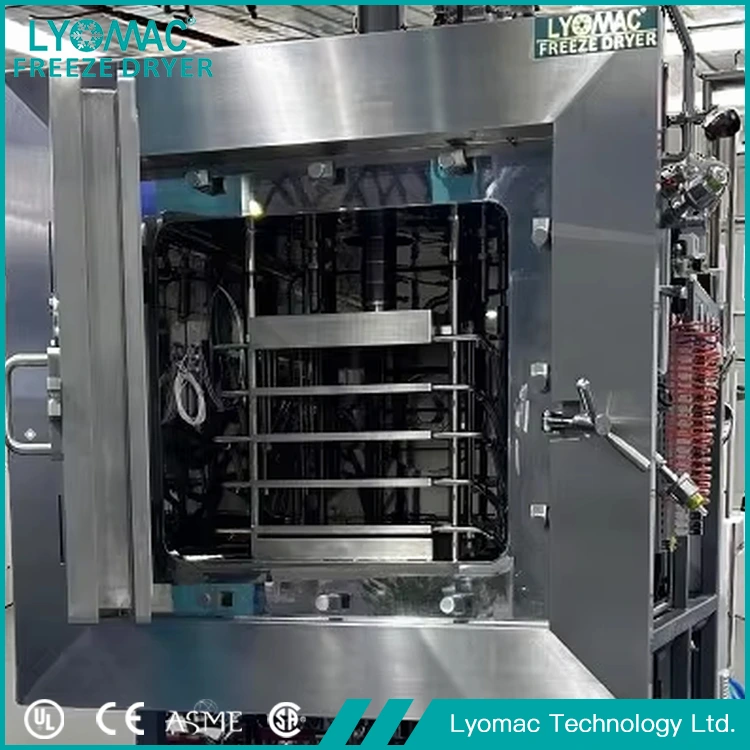
The Science Behind the Collapse: Eutectic vs. Collapse Temperature
Collapse occurs when the product temperature during primary drying rises above its glass transition temperature (Tg') or eutectic temperature (Teu) . At this critical point, the partially dried matrix loses structural rigidity. The ice crystals sublimate, but the surrounding amorphous phase flows like viscous syrup before it can form a stable porous network. This is not a failure of the Lab Lyophilizer For Samples itself—it is a failure of process design relative to the formulation's physical properties.
| Parameter | Effect on Cake Structure |
|---|---|
| Product temperature above Tg' | Viscous flow, shrinkage, and macroscopic collapse |
| Product temperature below Tg' | Rigid amorphous phase, stable porous cake |
| Over-rapid ramp rate | Localized melting due to uneven heat transfer |
| Insufficient vacuum level | Reduced sublimation rate, prolonged exposure to critical temperatures |
Three Primary Culprits in Your LYOMAC Cycle
1. Incorrect Shelf Temperature Setpoint
Many operators assume that higher shelf temperatures accelerate drying. However, if the shelf temperature drives the product temperature past its collapse point, the Lab Lyophilizer For Samples becomes a melting chamber rather than a drying chamber. LYOMAC systems provide precise shelf control, but the setpoint must be derived from thermal analysis (DSC or freeze-dry microscopy) of your specific formulation.
2. Chamber Pressure Too High
A vacuum level above 200–300 mTorr reduces the sublimation driving force. This forces the product to remain at an elevated temperature for longer periods, increasing the risk of collapse. LYOMAC vacuum sensors and controlled leak valves are designed to maintain optimal pressure, but regular calibration is non-negotiable.
3. Overloading the Vials or Trays
Filling depth directly impacts heat transfer. A deeper fill increases the thermal mass, causing the bottom layers to warm faster than the top, while the top surface sublimes. This uneven profile often pushes the lower portion past Tg' before primary drying completes. For LYOMAC users, adhering to the recommended fill volume per shelf area is critical.
Step-by-Step Troubleshooting Workflow
-
Step 1 – Confirm your formulation's Tg' using DSC. If unknown, run a conservative cycle at -40°C shelf temperature with a 50 mTorr setpoint.
-
Step 2 – Check the Pirani vs. capacitance manometer readings on your Lab Lyophilizer For Samples. A divergence indicates residual solvent or a leak—both of which alter collapse risk.
-
Step 3 – Reduce the ramp rate to 0.5°C/min during primary drying. LYOMAC systems support programmable ramps; use them.
-
Step 4 – Perform a freeze-dry microscopy test to visually confirm the maximum allowable product temperature for your batch.
Lab Lyophilizer For Samples – FAQ Common Questions
Q: Can I use the same primary drying temperature for all sample types in a Lab Lyophilizer For Samples?
A: Absolutely not. Each formulation has a unique Tg' or Teu, which depends on the excipients, buffer salts, and active ingredients. For example, sucrose-based formulations typically collapse around -32°C, while mannitol-based ones can tolerate -20°C. Running a universal temperature profile guarantees collapse for some batches. LYOMAC recommends performing a thermal characterization for each new formulation before scaling to production batches. The cost of a single DSC test is negligible compared to losing an entire batch.
Q: How do I know if the collapse happened during freezing or during primary drying in my Lab Lyophilizer For Samples?
A: This is a common diagnostic challenge. If collapse occurs during freezing (often due to slow cooling or insufficient nucleation), the cake will show large, irregular ice crystals and a coarse, sandy texture after drying—this is called "micro-collapse." If collapse occurs during primary drying, the cake appears glossy, shriveled, and melted, often with a distinct "ring" at the bottom of the vial. To differentiate, run a freeze-thaw test on a separate sample: freeze it in your LYOMAC chamber, then thaw it slowly and inspect the texture before drying. If it looks uniform, the problem is in primary drying; if not, adjust the freezing ramp to 1°C/min or use controlled nucleation accessories.
Q: Is it safe to increase vacuum level to compensate for a high shelf temperature in a Lab Lyophilizer For Samples?
A: No—and this is a dangerous misconception. Lowering chamber pressure increases the sublimation rate initially, but it also reduces heat transfer from the shelf to the vials (since gas conduction decreases). In practice, this can cause the product to cool below its optimal temperature, prolonging drying time without preventing collapse. Worse, if your Lab Lyophilizer For Samples lacks a capacitance manometer, you may misread total pressure versus water vapor partial pressure. LYOMAC engineers emphasize that vacuum and shelf temperature must be optimized together, not traded off. Always prioritize product temperature monitoring (using thermocouples or IR sensors) over simply adjusting pressure.
Preventive Strategy for LYOMAC Users
| Action | Frequency | Expected Outcome |
|---|---|---|
| Calibrate vacuum gauges (Pirani + capacitance) | Monthly | Accurate pressure control within ±5 mTorr |
| Perform a heat distribution test on shelves | Quarterly | Eliminate cold spots that cause uneven collapse |
| Run a small-scale cycle with thermocouples | Every new formulation | Identify true product temperature during primary drying |
| Update LYOMAC firmware for ramping algorithms | As released | Optimized PID control for thermal overshoot |
Final Check Before Your Next Run
Before loading your next batch into the Lab Lyophilizer For Samples, ask yourself: Do I know the exact Tg' of this formulation? Have I verified shelf uniformity across all positions? Is my vacuum pump oil fresh and my condenser temperature below -50°C? These three questions, when answered thoroughly, eliminate 90% of collapse events. LYOMAC systems are built with industrial-grade components, but even the best hardware cannot compensate for a cycle designed blindly.
Contact Us
If you have repeatedly faced collapsed cakes despite following these guidelines, or if you need assistance in designing a robust lyophilization cycle for your specific samples, the LYOMAC technical team is ready to help. We offer free cycle consultation, on-site vacuum calibration, and formulation analysis support for all registered users. Reach out to us through our official website or email our support desk—we will respond within 24 hours with a customized diagnostic checklist for your Lab Lyophilizer For Samples. Do not let another batch go to waste; let us work together to turn your freeze-drying process into a reliable, repeatable success.