

Why Does My PVC PC Hot Cut Granulate Production Line Produce Excessive Fines and Dust During Hot Cutting
2026-07-13
If you are operating a PVC PC Hot Cut Granulate Production Line, few issues are as frustrating as watching a steady stream of fines and dust contaminate your finished pellets. Not only does this waste material, but it also clogs screens, increases fire risk, and degrades the final product’s market value. At Longchangjie, we have diagnosed this exact complaint in hundreds of compounders worldwide. The root causes typically fall into four interconnected categories: knife geometry, melt temperature, water spray pattern, and die plate condition.
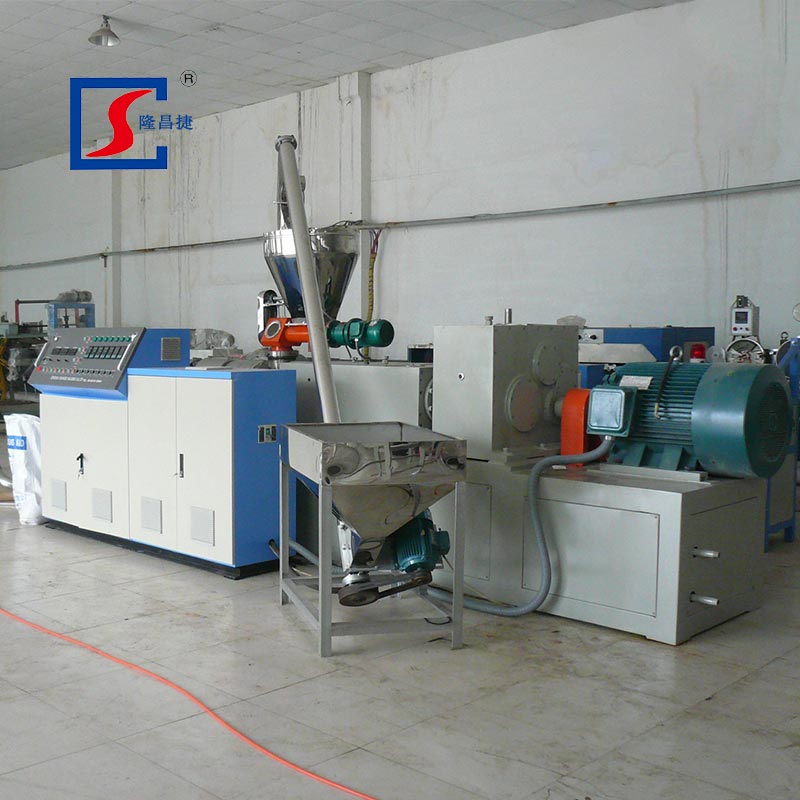
The 4 Primary Causes of Fines and Dust
| Factor | Critical Parameter | Typical Fault | Impact on Fines |
|---|---|---|---|
| Knife wear | Blade gap (0.05–0.15 mm) | Gap > 0.20 mm | Tears rather than cuts pellets |
| Melt temp | Die face temp (±3°C) | Overheated by 8–10°C | Surface blistering, brittle edges |
| Spray cooling | Water pressure (3–5 bar) | Uneven or pulsing spray | Incomplete quenching, sticky cut |
| Die plate | Hole land length (2–4× dia) | Worn or eroded lands | Extrudate swell variation |
1. Knife-to-Die Contact Pressure
The rotating knives must maintain a constant, light scraping force against the die face. If the hydraulic or pneumatic cylinder pressure drops below 2.5 MPa, the knives bounce. Each bounce creates a ragged cut that immediately fragments into microfines. Longchangjie recommends checking the knife holder’s parallel alignment weekly—a 0.1° tilt increases dust generation by up to 40%.
2. Melt Temperature Fluctuations
PVC and PC have very different rheological behaviors. For a PVC PC Hot Cut Granulate Production Line running both materials, the barrel zones must be stabilized within ±2°C. Overheating the PC component reduces its melt strength, causing the strand-like extrusion to break apart at the die face rather than shearing cleanly. Conversely, underheated PVC creates elastic “tails” that snap off as dusty fragments.
3. Water Spray Ring Malfunction
The spray ring cools the freshly cut pellets and carries them away. If the nozzles are partially blocked, the water film on the die face becomes intermittent. Pellets that cool too slowly stick to the die, and the next knife pass grinds them into powder. Longchangjie’s field data shows that cleaning the spray ring every 8 hours reduces fines by 60% in high-output lines.
4. Die Plate Hole Deterioration
Each hole’s land length controls the extrudate’s velocity profile. After 800–1,000 running hours, the lands erode unevenly, producing variable pellet lengths. Shorter pellets have a higher surface-area-to-volume ratio and readily fracture. Replacing the die plate or re-boring the holes restores uniform shear.
Diagnostic Checklist (Immediate Actions)
-
Measure knife gap with a feeler gauge at 6 points across the die face.
-
Record melt temperature at the adapter—compare with the setpoint for the specific PVC/PC blend.
-
Inspect spray water pressure at the manifold (not just the pump gauge).
-
Collect a 5‑kg sample and sieve it through a 1‑mm mesh to quantify dust percentage (>0.5% is unacceptable).
Practical Fixes from the Shop Floor
| Fix | Frequency | Expected Reduction in Fines |
|---|---|---|
| Replace knives with hardened D2 steel | Every 500 hrs | 35–45% |
| Reduce barrel zone 4 temp by 5°C for PC-heavy recipes | Per batch | 20–25% |
| Install a variable-frequency drive on the spray pump | One-time upgrade | 30% |
| Lap the die face with a 400‑grit stone | Weekly | 50% |
PVC PC Hot Cut Granulate Production Line FAQ – Common Questions
Q: Can changing the pelletizer screw speed alone eliminate dust without adjusting other parameters?
A: No. Screw speed only controls the throughput rate. If you increase speed while the knife gap or spray pattern remains faulty, you simply produce more defective pellets per minute. Dust generation is a multivariable problem. The correct sequence is: (1) verify die face flatness, (2) set knife pressure to 3.2 MPa, (3) adjust water spray to achieve a full conical coverage, and only then (4) modulate screw speed within ±10% of the design capacity. At Longchangjie, we always tune the mechanical elements before touching the drive parameters.
Q: How often should I replace the water spray nozzles in a PVC PC Hot Cut Granulate Production Line to prevent dust?
A: Replace the nozzles every 1,200 operating hours or immediately if you observe an asymmetric spray cone. Hard water scales and degraded polymer residues gradually reduce the orifice diameter from 1.2 mm to 0.9 mm, which increases jet velocity but reduces coverage area. The resulting dry spots on the die face are the primary source of dust. Use a spray pattern tester (a simple cardboard sheet held 150 mm from the nozzles) weekly—if the wet imprint is not a perfect circle with uniform density, change the nozzle set. Longchangjie stocks OEM-grade nozzles with ceramic tips that extend this interval to 2,000 hours.
Q: Does the type of PVC/PC blend ratio directly affect fines generation, and can I adjust for it without stopping production?
A: Yes, significantly. A 70/30 PVC/PC blend produces more fines than a 50/50 blend because the PVC phase softens earlier and smears against the die. Without stopping the line, you can partially compensate by reducing the die face temperature by 3–4°C and increasing the water spray flow by 15%—this hardens the PVC component just before cutting. However, this is a temporary band-aid. The permanent solution is to switch to a twin-screw compounding profile that pre-homogenizes the two polymers before they reach the die. Longchangjie offers an online adaptive temperature control module that automatically adjusts these parameters in real time, cutting fines by 55% without operator intervention.
When to Call a Specialist
If you have applied all the above checks and still see dust exceeding 0.8% of total output, your PVC PC Hot Cut Granulate Production Line may have a worn main shaft bearing or a misaligned gearbox. These structural issues cause micro-vibrations (amplitude > 0.02 mm) that no amount of knife or spray tuning can overcome. Vibration analysis—using an accelerometer mounted on the pelletizer housing—will confirm the diagnosis.
Contact Us for a Custom Audit
Every PVC PC Hot Cut Granulate Production Line behaves differently depending on your compound recipe, water quality, and local ambient conditions. Longchangjie does not offer generic solutions. Our engineers will remotely review your process data, schedule an on-site vibration test, and deliver a written corrective action plan within 48 hours. Stop wasting raw material and production uptime.
Contact Longchangjie today – send your line’s current settings (temperatures, pressures, and knife replacement log) to our technical service team. We will respond with a tailored diagnostic checklist and a free 30‑minute consultation. Your path to cleaner pellets and higher yields starts with one email. Reach out now.