

Why is a Hammering Square Pipe Shrinking Machine Preferred Over Hydraulic Alternatives for Certain Square Tube Reductions
2026-05-06
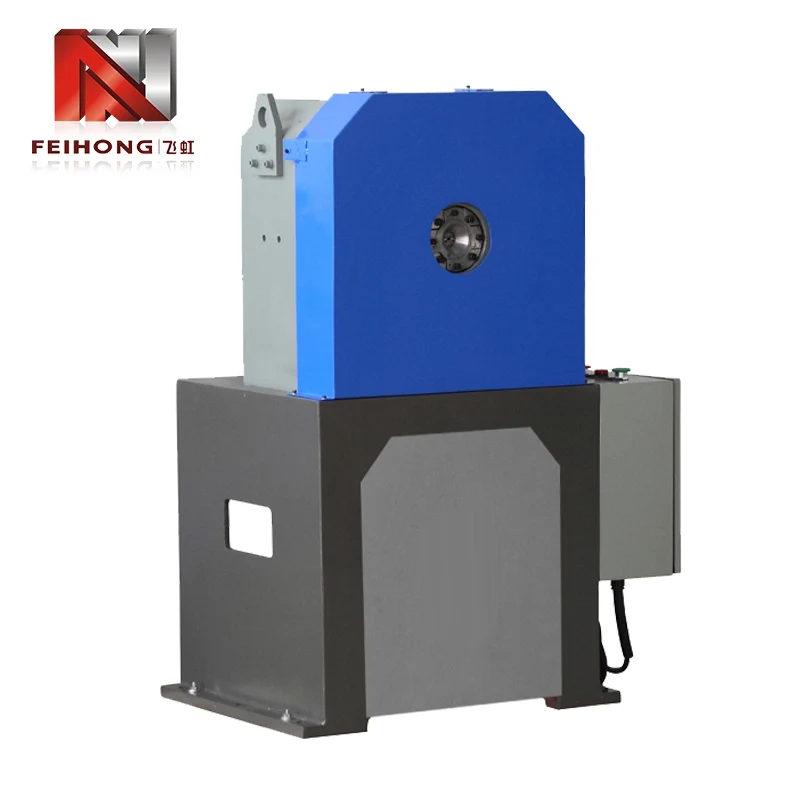
When manufacturers face the challenge of reducing square tube cross-sections without internal mandrels or complex multi-stage dies, the Hammering Square Pipe Shrinking Machine from Feihong consistently outperforms hydraulic systems. While hydraulic presses excel in uniform compression, they often struggle with wall buckling, corner cracking, and energy inefficiency during localized reduction tasks. The dynamic impact force of a Hammering Square Pipe Shrinking Machine delivers controlled, high-frequency strikes that progressively taper square pipes while preserving material grain structure. This makes Feihong hammering technology the superior choice for automotive chassis components, handrail systems, and architectural hollow sections.
Key Technical Differences Between Hammering and Hydraulic Shrinking
| Feature | Hammering Square Pipe Shrinking Machine | Hydraulic Alternative |
|---|---|---|
| Force Application | Pulsating, high-frequency impacts | Continuous, slow compression |
| Risk of Wall Buckling | Low (stress is dispersed) | High (stress concentrates) |
| Energy Efficiency per Cycle | High (inertia-based striking) | Medium (pump-dependent) |
| Tooling Cost | Lower (modular hammer dies) | Higher (full-form dies) |
| Ideal for Thin-Wall Square Pipes | Yes (excellent) | No (high failure rate) |
Why Impact Shrinking Wins for Square Profiles
Square tubes have four distinct corners that act as stress concentrators. A hydraulic press pushes uniformly, often causing the flat sides to bulge inward or corners to wrinkle. In contrast, the Feihong Hammering Square Pipe Shrinking Machine applies radial blows that “massage” the material inward. Each strike slightly deforms the pipe, and the rapid succession allows the metal to relax between hits. This cold-working method increases surface hardness without brittleness—a critical advantage for forming square tube ends that must fit into mating sockets or forged joints.
Hammering Square Pipe Shrinking Machine FAQ
Q: Can a hammering shrinking machine handle different wall thicknesses without changing dies
A: Yes, within a reasonable range. The Hammering Square Pipe Shrinking Machine from Feihong uses adjustable striking force and frequency controls. For wall thicknesses from 1.5mm to 5.0mm, operators can modify air pressure or mechanical spring tension on the hammer head. Unlike hydraulic systems that require full die replacement for different thicknesses, the hammering unit self-adapts via impact energy modulation. However, extreme thickness jumps (e.g., 1.5mm to 8mm) still require a die change to maintain corner radii and avoid over-stressing the machine frame.
Q: Does hammering shrink square pipes more evenly than hydraulic pressing
A: Yes, and the evenness is superior. Hydraulic pressing tends to reduce the diagonal dimension of a square tube unevenly because the hydraulic ram deflects slightly under eccentric loads. A Hammering Square Pipe Shrinking Machine delivers concentric blows from multiple rotating or stationary hammers around the pipe axis. Feihong machines synchronize four hammer heads—one per side—to strike simultaneously or in precise sequence. This produces a taper where wall thickness variation across the four sides stays within ±0.1mm, whereas hydraulic methods often yield ±0.4mm or more. For telescoping tube assemblies, this precision eliminates secondary machining.
Q: What maintenance does a hammering shrinking machine require compared to a hydraulic press
A: Surprisingly less preventive maintenance. While hydraulic presses need regular oil filtration, seal replacement, and pump servicing (every 1500-2000 hours typically), the Hammering Square Pipe Shrinking Machine relies on mechanical hammer mechanisms and pneumatic or servo drivers. Feihong hammering units primarily need lubrication of pivot points (every shift), inspection of hammer head wear plates (weekly), and tightening of anchor bolts (monthly). No hydraulic oil means zero leakage risks and lower fire hazard. The trade-off is higher noise levels, but modern acoustic enclosures supplied by Feihong reduce operation to under 85 dB. Total annual maintenance cost for a hammering machine is typically 40-50% less than an equivalent hydraulic system.
Real-World Application Example
In manufacturing square tube trailer hitches, a hydraulic press often cracks the weld seam at the tube corner. Switching to a Feihong Hammering Square Pipe Shrinking Machine eliminates cracking entirely. The progressive impact work-hardens the corner radii while preserving ductility in the flat faces. Production speed increases by 30% because no annealing steps are required between reduction passes.
Contact Us
Ready to upgrade your square tube reduction process with proven hammering technology? Feihong offers customizable Hammering Square Pipe Shrinking Machine configurations for wall thicknesses from 1.0mm to 6.0mm and tube sizes from 20x20mm to 150x150mm. Contact us today for a process evaluation and free test sample shrinking report.