

Why Is a Microcomputer Controlled Flat Diagonal Arm Screen Printing Machine Ideal for High-Volume Production
2026-10-28
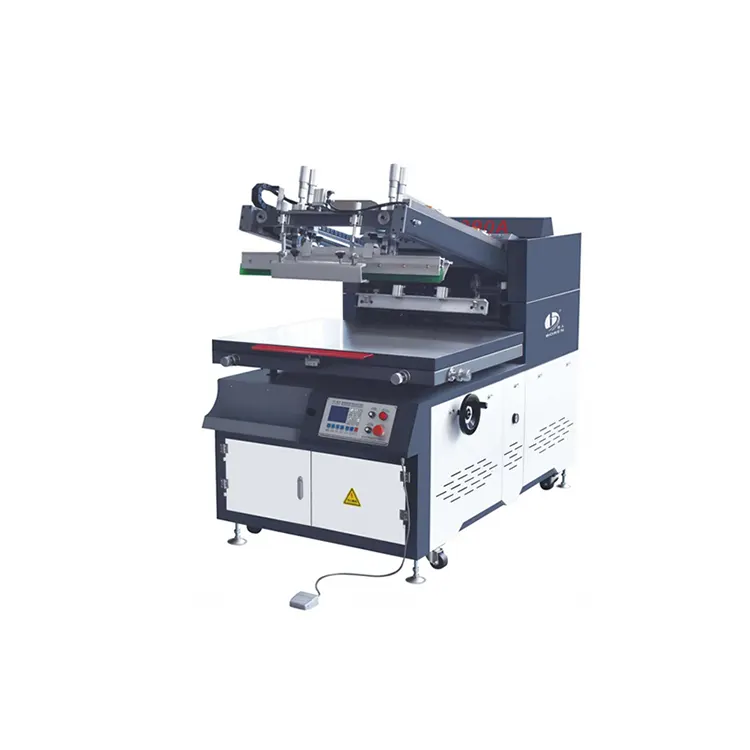
High-volume screen printing demands consistent pressure, repeatable registration, and minimal downtime—three areas where manual presses consistently fall short. A Microcomputer Controlled Flat Diagonal Arm Screen Printing Machine addresses these challenges directly by combining programmable logic control with a rigid diagonal arm structure, and Green Ohm has engineered its platform specifically for shops that run long production cycles. This article examines the mechanical and control-level reasons these machines outperform alternatives when throughput and yield matter most.
The Core Advantage: Control Meets Structure
The diagonal arm design distributes squeegee force along a stable axis, reducing deflection during high-speed strokes. When paired with microcomputer control, every parameter—flood speed, print speed, squeegee pressure, and stroke length—becomes a stored, repeatable value. Green Ohm builds its control system around servo-driven actuation, which means the settings you validate on the first piece remain identical on the ten-thousandth.
| Production Factor | Manual / Pneumatic Press | Microcomputer Controlled Flat Diagonal Arm Screen Printing Machine |
|---|---|---|
| Registration repeatability | ±0.10–0.20 mm, operator-dependent | ±0.02–0.05 mm, program-locked |
| Cycle time consistency | Varies with operator fatigue | Constant across shifts |
| Changeover time | 20–40 minutes | 5–10 minutes with recipe recall |
| Squeegee pressure drift | Requires periodic adjustment | Closed-loop monitored |
| Operator skill requirement | High | Moderate |
Why High-Volume Runs Benefit Most
-
Recipe memory eliminates setup drift. Once a job is dialed in, the parameters are recalled by code, not by memory. Green Ohm systems store multiple job profiles, so repeated orders start at validated settings.
-
Throughput scales without adding skilled labor. Because the Microcomputer Controlled Flat Diagonal Arm Screen Printing Machine handles stroke consistency automatically, one operator can supervise multiple units.
-
Waste drops at the front end. First-piece approval time shortens, and misprints from pressure variation decline measurably—critical when substrate costs are high.
-
Predictive maintenance reduces unplanned stops. Green Ohm integrates cycle counters and fault logging, allowing maintenance scheduling around production windows rather than breakdowns.
FAQ
Q: How does microcomputer control improve registration on a flat diagonal arm press?
A: The controller synchronizes squeegee and flood stroke positions with the screen frame's mechanical reference, locking each axis to a stored coordinate. This removes the operator-dependent variance inherent in manual adjustment and holds registration within a narrow tolerance across the entire run.
Q: Can a Microcomputer Controlled Flat Diagonal Arm Screen Printing Machine handle different substrate thicknesses without mechanical reset?
A: Yes. Print parameters and arm height offsets are stored per job recipe, so switching between substrates requires recalling a profile rather than re-shimming or re-adjusting the arm. Green Ohm machines allow fine offset tuning within the recipe for edge cases.
Q: What production metrics should a shop track after installing this type of press?
A: Track first-piece approval time, misprint rate, average cycle time per stroke, changeover duration, and unplanned downtime hours. These five metrics reveal whether the Microcomputer Controlled Flat Diagonal Arm Screen Printing Machine is delivering its intended throughput and yield gains.
Conclusion
For operations where volume, repeatability, and labor efficiency determine margin, the Microcomputer Controlled Flat Diagonal Arm Screen Printing Machine is not a luxury—it is a production necessity. Green Ohm supports this transition with application engineering, recipe development, and after-sales service tailored to high-volume environments. Contact us today to discuss your throughput targets and request a production assessment for your facility.