

Why Is FRP Scrubber Technology Becoming the Preferred Solution for Industrial Air Pollution Control?
2025-12-01
FRP Scrubber technology has rapidly become a central component of industrial air-pollution management across chemical processing, wastewater treatment, pharmaceutical manufacturing, metal plating, fertilizer production, and numerous other emissions-intensive sectors. Built from Fiber-Reinforced Plastic (FRP), these scrubbers offer superior corrosion resistance, lower lifecycle cost, and stable performance under harsh chemical environments compared with steel or traditional materials.
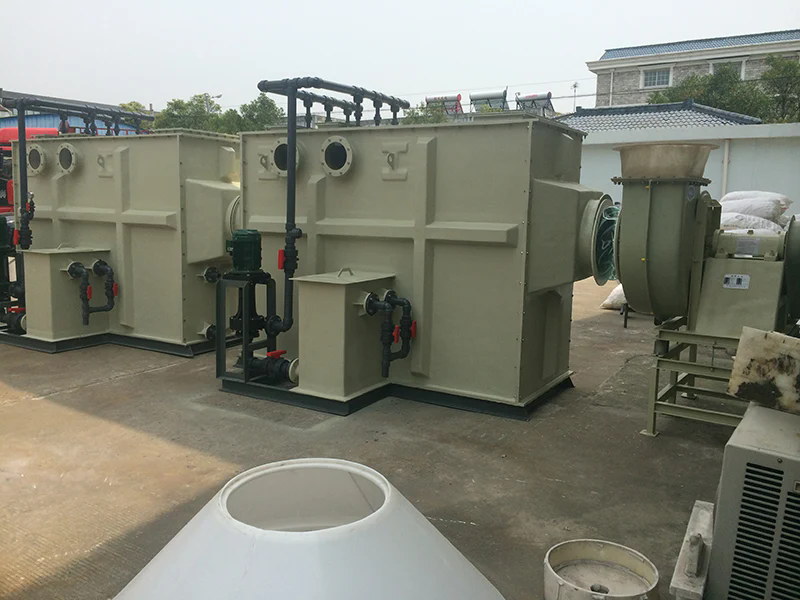
FRP scrubbers are engineered to remove hazardous gases—such as HCl, SO₂, NH₃, Cl₂, NOₓ, HF, and organic odors—by enabling mass transfer between polluted air and a neutralizing liquid. The result is safer emissions that comply with environmental regulations while extending equipment longevity. This article integrates technical specifications, common questions, engineering considerations, and the rising market trend positioning FRP scrubbers as a long-term industrial standard.
Technical Specifications & Performance Parameters
Below is a structured parameter overview designed to meet the needs of engineers, procurement professionals, and facility managers who require quantifiable performance metrics before selecting or upgrading air-treatment systems.
Key Technical Parameters of FRP Scrubbers
| Specification Category | Typical FRP Scrubber Parameter Range | Description |
|---|---|---|
| Material Composition | FRP (unsaturated polyester, vinyl ester, epoxy resin reinforced with glass fiber) | Provides exceptional corrosion and chemical resistance |
| Diameter Range | 600 mm – 6000 mm | Customizable based on airflow volume |
| Height Range | 2 m – 20 m | Designed according to absorption efficiency and treatment stages |
| Airflow Capacity | 1,000–100,000+ m³/hr | Scalable for small labs to heavy-duty industrial plants |
| Operating Temperature | −40°C to 120°C (depending on resin grade) | Suitable for high-temperature and corrosive environments |
| Pressure Drop | 25–1000 Pa | Determined by packing type and scrubber configuration |
| Efficiency | 85%–99.9% depending on pollutant | High removal rate for acidic, alkaline, and organic gases |
| Configuration Options | Vertical/Horizontal, Single-stage, Two-stage, Multi-stage | Flexible layouts for site convenience |
| Packing Media | PP random packing, structured packing, ceramic packing | Enhances gas–liquid contact efficiency |
| Service Life | 15–25 years | Extended lifetime with minimal corrosion |
| Maintenance Cycle | 6–12 months inspection | Easy to maintain due to lightweight structure |
These specifications support application flexibility while achieving high removal efficiency for industries requiring strict emissions standards.
In-Depth Analysis — Why FRP Scrubbers Dominate Industrial Pollution Control
Why do industries increasingly select FRP scrubbers over metal scrubbers?
FRP scrubbers outperform conventional metal scrubbers in several critical aspects:
-
Superior Corrosion Resistance
The stable resin matrix resists deterioration from acids, alkalis, solvents, chlorine-based gases, and oxidizing chemicals. This eliminates the severe corrosion issues common in steel scrubbers. -
Lower Lifetime Cost
FRP scrubbers avoid the need for anti-corrosion coatings, expensive alloys, or frequent replacement, making them cost-efficient across a 15–25-year lifespan. -
Lightweight Construction
Their structural weight is significantly lower than metal, allowing easy transportation, rooftop installation, and reduced structural load requirements. -
High Design Flexibility
FRP is moldable. Engineers can achieve customized shapes, diameters, and internal structures to match facility constraints and performance targets. -
Stable Operation Under Chemical Stress
FRP remains mechanically stable even under fluctuating pH, temperature swings, and corrosive byproducts. -
Compliance With International Emission Regulations
FRP scrubbers help industries maintain strict regulatory requirements in the US, Europe, Middle East, and Asia due to their reliable pollution-removal performance.
What Role Does an FRP Scrubber Play in Industrial Gas Treatment?
An FRP scrubber performs three essential functions:
-
Gas–Liquid Absorption
Polluted air enters the scrubber and flows through packing media, maximizing contact area with the scrubbing liquid. Neutralizing reactions convert harmful gases into harmless compounds. -
Particulate Removal (Optional Configuration)
In facilities with dust and chemical vapor mixtures, scrubbers incorporate mist eliminators and droplet separators to prevent liquid carryover and improve output air purity. -
Odor Control and VOC Removal
Through multi-stage absorption and optional biological layers, FRP scrubbers efficiently remove odor-generating organic compounds from wastewater and food processing plants.
How Does an FRP Scrubber Operate From Air Intake to Clean Gas Output?
Step-by-Step Functional Process:
-
Contaminated air enters through an inlet duct at controlled velocity.
-
Air moves upward or horizontally through packed stages.
-
Scrubbing liquid is sprayed from the top, circulating through spray nozzles to wet the packing bed.
-
Mass transfer occurs, converting harmful gases into neutralized products.
-
Treated air passes through demisters to remove entrained droplets.
-
Clean air is released into the atmosphere following regulatory standards.
-
Used liquid is collected, monitored, and either recirculated or discharged after treatment.
This process ensures continuous and stable purification performance with minimal operator intervention.
Future Trend — Why FRP Scrubbers Will Shape the Next Generation of Emission Control
The global shift toward environmental sustainability is increasing demand for FRP scrubbers, particularly in chemical, semiconductor, and renewable-energy industries. Several emerging trends define the future development of FRP scrubbers:
1. Integration With Smart Monitoring Systems
IoT sensors are being incorporated to measure pH, airflow, pressure drop, pollutant concentration, and scrubbing liquid quality. These enable real-time control and data-driven maintenance strategies.
2. Enhanced Resin Formulations
New resin technologies—such as brominated vinyl ester, nano-reinforced resin, and fire-retardant matrix materials—increase heat resistance, mechanical strength, and flame resistance.
3. Multi-Stage Hybrid Scrubbers
Future FRP scrubbers combine absorption, oxidation, and biological treatment in a single system to address increasingly complex industrial emissions.
4. More Sustainable Manufacturing
Growing emphasis on recyclability and low-emission FRP manufacturing processes contributes to greener construction of air-pollution systems.
5. Larger, Modular, and Space-Optimized Designs
As industrial facilities expand, modular FRP units allow rapid installation, relocation, or capacity upgrading without major structural changes.
Common Questions About FRP Scrubbers
Q1: What type of gases can an FRP scrubber effectively remove?
A: FRP scrubbers efficiently treat a wide spectrum of industrial gases, including corrosive acid gases such as hydrochloric acid, sulfur dioxide, hydrofluoric acid, and nitric oxides; alkaline gases like ammonia; toxic gases such as chlorine; and odor-producing VOCs. Their material stability allows continuous operation even under extreme chemical conditions, making them suitable for chemical plants, waste-gas neutralization systems, and large-scale industrial exhaust treatment.
Q2: How often does an FRP scrubber require maintenance?
A: Routine inspection is recommended every 6–12 months. Maintenance includes cleaning packing media, checking nozzles, monitoring liquid pH, inspecting demisters, and verifying structural integrity. Due to corrosion resistance, FRP scrubbers require significantly less maintenance than metal systems, reducing downtime and operational costs. Well-maintained FRP scrubbers consistently retain high removal efficiency over their lifetime.
Premium Solutions From Xinda Chemical
The evolution of FRP scrubber technology is empowering industries to achieve safer emissions, higher efficiency, and long-term environmental compliance. With durable FRP construction, flexible design capability, and exceptional resistance to corrosive chemicals, this technology is projected to remain a key pillar in industrial gas-treatment systems across global markets.
Xinda Chemical delivers engineering-grade FRP scrubbers with precision manufacturing, tailored configurations, and end-to-end technical support to meet the diverse requirements of modern industrial facilities. For comprehensive consultation, customized solutions, and detailed product selection guidance, contact us to discuss how FRP scrubber systems can elevate your environmental performance and operational reliability.