

Why Is My Card Paper Grooving Machine Creating Uneven Groove Depths on Coated Stock
2026-06-29
Coated paper stock is a favorite in premium packaging, luxury cartons, and high-end display boxes because of its smooth finish and vibrant print quality. However, when you run coated stock through a Card Paper Grooving Machine, uneven groove depths can suddenly appear—shallow in some spots, too deep in others, or even skipping entirely. This defect ruins fold quality, creates cracking along the spine, and wastes expensive material. If you are facing this issue, you are not alone. The culprit is rarely the machine alone; it is usually a combination of material behavior, setup errors, and tooling wear. At Rongda, we have diagnosed hundreds of such cases across converting shops worldwide. Below is a professional breakdown of why this happens and how to fix it.
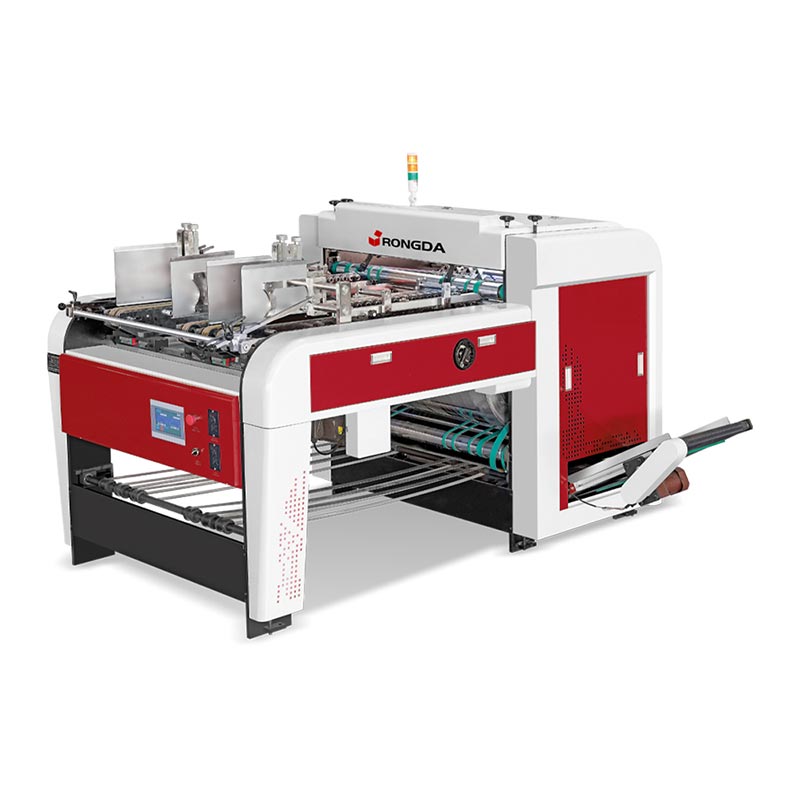
1. The Coating Itself Changes Friction and Hardness
Coated stock has a clay-based or synthetic top layer that is harder and more slippery than uncoated board. This coating reduces the grip between the feed rollers and the paper surface. When the Card Paper Grooving Machine pulls the sheet through, micro-slippage causes the grooving blade to engage at slightly different timings across the sheet width. The result? Deeper grooves where the sheet stalls momentarily, and shallower grooves where it slides faster.
| Material Factor | Effect on Groove Depth | Recommended Check |
|---|---|---|
| High coating weight (g/m²) | Increases surface hardness, resists blade penetration | Reduce feeding speed by 15–20% |
| Low moisture content (<6%) | Makes coating brittle, causes erratic cutting resistance | Condition stock to 8–10% RH for 24 hours |
| Uneven coating thickness across web | Creates variable blade pressure points | Measure caliper at 5 points across the sheet |
2. Blade Wear Is Not Uniform Across the Width
In a typical Card Paper Grooving Machine, the grooving blade or creasing matrix wears faster in the center because that is where most production runs concentrate. Coated stock accelerates this wear because the abrasive minerals in the coating act like fine sandpaper. A blade that is 0.05 mm flatter in the middle will produce a groove 0.15 mm shallower there—enough to cause folding failure.
Practical test: Run a plain uncoated board through the same Card Paper Grooving Machine. If groove depth becomes uniform again, your blade is wearing unevenly due to coated stock. Replace or regrind the blade, and consider using Rongda’s carbide-tipped grooving knives, which are engineered specifically for abrasive coated materials.
3. Pressure Roller Settings Are Not Adjusted for Coated Thickness Variations
Coated stock often has a tighter thickness tolerance than virgin board (±0.02 mm vs. ±0.05 mm), but that small range still matters. Most operators set the pressure roller gap once and forget it. However, coated stock’s compressibility is lower, meaning the same gap that works for uncoated board will over-compress some areas and under-compress others, especially if the sheet has slight curl or warp.
| Parameter | Uncoated Board | Coated Stock (Recommended) |
|---|---|---|
| Roller gap (relative to caliper) | Caliper – 0.10 mm | Caliper – 0.05 mm (tighter) |
| Feed roller durometer (hardness) | 80 Shore A | 90 Shore A for better grip |
| Grooving speed (m/min) | 120 | 90–100 (slower for coated) |
4. Dust and Coating Residue Build-Up on the Anvil
Coated stock sheds fine white dust—a mixture of clay and binder—during grooving. This dust accumulates on the anvil (the bottom support roll) and changes the effective contact angle. A 0.1 mm layer of compacted dust raises the sheet locally, creating shallower grooves in those spots. Clean the anvil every 200–300 sheets when running coated stock, and use Rongda’s anti-static air blow-off kit to keep the groove area clear.
5. The Grooving Depth Calibration Drifts with Machine Temperature
After 30–40 minutes of continuous running, the frame of any Card Paper Grooving Machine expands slightly from heat generated by friction. Coated stock, because it requires more cutting force, generates more heat. A 5°C rise in the tool holder can change the blade penetration by 0.08 mm—enough to create visible depth variation. Rongda machines feature a thermal-compensated grooving head that automatically adjusts for this drift, but if you are using an older model, schedule a warm-up recalibration every hour.
FAQ – Common Questions About Card Paper Grooving Machine Performance on Coated Stock
Q1: Can I run coated stock on any standard Card Paper Grooving Machine, or do I need a special model?
A1: You can run coated stock on most standard Card Paper Grooving Machine models, but the results depend heavily on blade geometry and roller surface. Coated stock requires a sharper blade angle (preferably 52° instead of the standard 60°) and a highly polished anvil to prevent scoring. If your machine does not allow blade angle changes, you will likely see uneven depths. Rongda offers a dedicated coated-stock package that includes a micro-grain carbide blade, a hardened anvil with a ceramic coating, and variable-frequency drive for speed control—all of which reduce depth variation by up to 70% without replacing the entire machine.
Q2: How often should I replace the grooving blade when processing coated stock vs. uncoated board?
A2: For uncoated board, a standard steel blade lasts approximately 50,000–80,000 linear meters. For coated stock, that life drops to 12,000–18,000 linear meters because of the abrasive minerals. However, you should not wait for visible dullness. Measure groove depth every 2,000 sheets using a digital depth gauge. When you see a deviation greater than ±0.05 mm from your target, replace the blade immediately. Rongda recommends using our dual-edge blades, which give you a second cutting edge after the first wears out—effectively doubling your tool life and reducing changeover downtime.
Q3: Why does the groove depth vary more at the edges of the sheet than in the middle when using coated stock?
A3: This is a classic symptom of edge-wave distortion. Coated stock often has a slightly higher moisture content at the edges than in the center because of how coating dries during manufacturing. The edges expand more, creating a convex cross-section. When this sheet enters the Card Paper Grooving Machine, the pressure roller contacts the center first, pushing the edges downward unevenly. As a result, the blade engages deeper at the edges (where the sheet is lower) and shallower in the middle. To fix this, install edge-support guides or pre-condition your coated stock in a humidity-controlled room for 12 hours before running. Rongda’s servo-driven pressure system can also map the sheet profile and apply variable pressure across the width, compensating for this edge-to-center variation automatically.
Final Checklist for Consistent Grooving on Coated Stock
-
Measure sheet caliper at 5 points – reject if variation > 0.03 mm
-
Clean anvil and blade holder after every 300 sheets
-
Reduce speed to 90 m/min and increase roller nip pressure by 10%
-
Use a carbide blade with 52° rake angle
-
Recalibrate depth zero after every 45 minutes of running
-
Log depth readings hourly – track trends, not just single values
When to Call a Specialist
If you have applied all the above checks—adjusted speed, changed blades, cleaned anvils, and conditioned your stock—but your Card Paper Grooving Machine still produces uneven grooves on coated stock, the issue may lie in the machine’s parallel alignment or bearing preload. These are not user-serviceable adjustments. Attempting to fix them without proper tools can misalign the entire grooving station permanently.
Contact us at Rongda for a remote diagnostic session or an on-site service visit. Our technical team specializes in coated stock challenges and can provide a tailored setup protocol for your specific material and production volume. We also offer retrofitting kits that convert standard grooving units into coated-material-ready systems. Send us a sample of your coated board and a video of the uneven grooving pattern, and we will reply with a root-cause analysis and a correction plan within 48 hours. Reach out to our service desk via the contact form on our official website—we are ready to help you achieve consistent, crack-free folds on every single sheet.