

Why Is My IR Textile Tunnel Dryer for T Shirt Not Curing Dark Garments Evenly
2026-06-11
If you operate a screen printing shop, you have likely faced this frustrating issue. You run a batch of dark T‑shirts through your IR Textile Tunnel Dryer for T Shirt, but the cure is patchy. Some areas feel slightly tacky, while others show minor cracking after a stretch test. This uneven curing is not a sign of a failing machine. Instead, it points to specific technical factors related to infrared energy absorption on dark substrates. At HOYSTAR, we have helped hundreds of printers solve this exact problem by adjusting a few key variables.
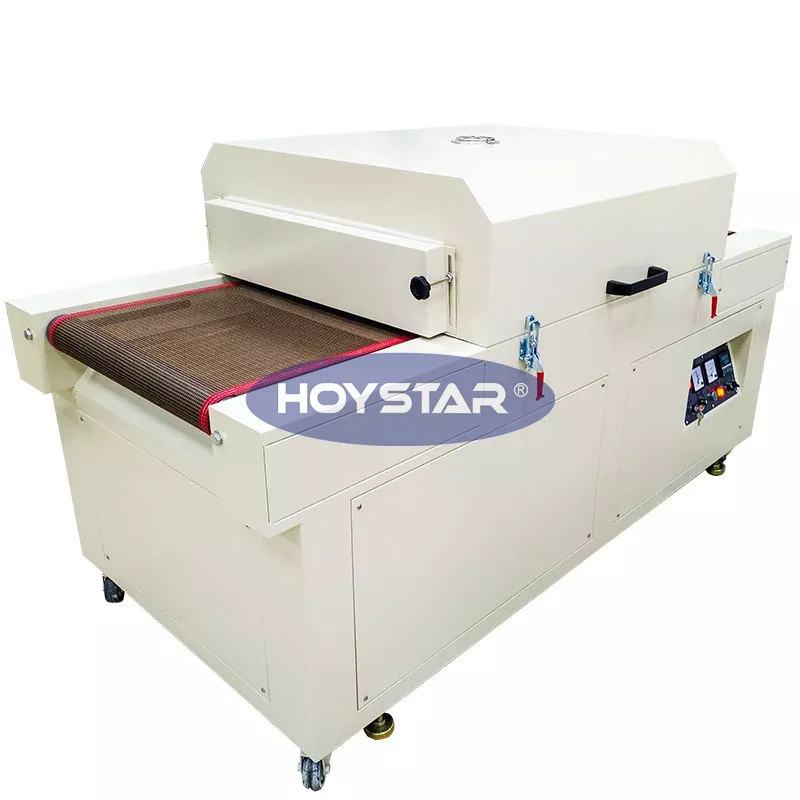
Why Dark Garments Are Different
Dark fabrics (black, navy, forest green) absorb infrared radiation differently than white or light shirts. An IR Textile Tunnel Dryer for T Shirt works by emitting infrared waves that directly heat the ink and the substrate. Dark pigments reflect less IR energy and convert more of it into heat, faster. This rapid heat build‑up can lead to surface curing without proper through‑cure, especially if belt speed or emitter distance is not calibrated for dark garments. Below are the most common technical reasons for uneven curing.
| Problem Area | Effect on Dark Garments | Recommended Fix by HOYSTAR |
|---|---|---|
| Emitter height too low | Over‑heating surface, under‑heating ink base | Raise emitters to 4–5 inches above the garment |
| Belt speed too fast | Insensitive dwell time | Reduce belt speed by 15‑20% for dark loads |
| Uneven emitter output | Hot and cold zones across belt | Clean reflectors and replace aging IR tubes |
| Ink film thickness | Varies more on dark rough fabrics | Use lower mesh counts and stir ink thoroughly |
How to Diagnose and Fix Uneven Curing
Start with a simple temperature mapping test. Place a heat‑sensitive label or a thermocouple at three points: left, center, and right of the belt. Run a dark T‑shirt through your IR Textile Tunnel Dryer for T Shirt at your normal settings. If the variance exceeds ±10°F (5.5°C) across the width, you have an airflow or emitter imbalance. Clean the IR reflectors with isopropyl alcohol. Dust and residue scatter the beam, creating cold zones. HOYSTAR machines feature segmented emitters, but even then, quarterly cleaning is essential.
Second, check the belt tension. A loose belt can cause the T‑shirt to flutter, changing the distance from the IR emitters mid‑cycle. Dark garments need a stable distance because their high absorption rate makes them sensitive to even small gaps of 0.5 inches.
Third, review your ink system. Some low‑quality plastisols do not respond evenly to IR heat. Switch to a premium ink designed for IR curing, or add a black‑fabric underbase. HOYSTAR recommends using a white underbase on dark shirts even for dark inks, because the white layer reflects excess heat and allows the top color to cure uniformly.
Common Mistakes Printers Make
-
Running dark and light garments together without adjusting settings.
-
Assuming the same belt speed works for 100% cotton and poly‑cotton blends.
-
Ignoring emitter warm‑up time (wait 10 minutes after power‑on).
-
Using damaged IR tubes (visible black spots on the glass).
IR Textile Tunnel Dryer For T Shirt – FAQ
Q: Why does my dark T‑shirt cure perfectly on the edges but remain tacky in the middle?
A: This is a classic sign of emitter degradation or improper reflector alignment. The middle of the belt receives less focused IR energy because the ceramic or quartz tubes wear unevenly in the center. First, inspect your IR tubes for dark patches. Replace any tube that shows uneven glow. Second, adjust the reflector angles if your HOYSTAR model has adjustable reflectors. Finally, run a “middle‑heavy” load: position dark garments slightly off‑center to use the higher output zones while you order replacement tubes.
Q: Can humidity in my work area affect how an IR textile tunnel dryer cures dark garments?
A: Yes, significantly. Dark fabrics absorb moisture from humid air more than light fabrics because their dense dye structure tends to retain water. When a moist dark T‑shirt enters the IR Textile Tunnel Dryer for T Shirt, the IR energy first evaporates that moisture instead of curing the ink. This steals heat energy and leads to under‑cured ink on the inner fibers. Keep your production humidity below 55%. If you work in a humid region, add a dehumidifier near the dryer infeed. HOYSTAR offers an optional air knife that blows ambient moisture off garments before they enter the tunnel.
Q: What belt speed should I start with for 100% cotton black T‑shirts using plastisol ink?
A: Set your HOYSTAR IR Textile Tunnel Dryer for T Shirt to a belt speed of 1.8–2.2 feet per minute (55–67 cm/min) with emitters at 400°C (752°F) surface temperature. Verify the ink reaches 160°C (320°F) for at least 45 seconds. Dark cotton absorbs heat fast, so a slower speed than you would use for white shirts is critical. Measure the shirt’s surface temperature immediately after exit using a non‑contact IR thermometer. If it exceeds 180°C (356°F), increase belt speed slightly; if below 150°C (302°F), decrease speed. Every shop’s ambient temperature and airflow differ, so always perform a stretch‑and‑wash test on the first five pieces.
Final Troubleshooting Table for Quick Reference
| Symptom | Likely Root Cause | HOYSTAR Solution |
|---|---|---|
| Ink rubs off after washing | Under‑cured due to high belt speed | Reduce speed by 10%, increase temp by 10°C |
| Scorched shirt surface | Emitter height too low | Raise emitters to min 4 inches |
| Random small uncured spots | Dirty reflectors or damaged IR tube | Clean reflectors; replace faulty tube |
| Consistent band of under‑cure | Belt misalignment creating a shadow | Center the belt and check tracking rollers |
Uneven curing on dark garments is solvable with systematic adjustments to belt speed, emitter height, and maintenance. HOYSTAR designs every IR Textile Tunnel Dryer for T Shirt with user‑accessible controls and robust IR emitters to handle high‑absorption fabrics reliably.
Contact Us
Does your IR Textile Tunnel Dryer for T Shirt still show uneven results after trying these steps? The HOYSTAR technical team is ready to help. Send us your belt speed, emitter temperature, and a photo of the cured shirt – we will reply within 24 hours with a customized cure recipe. Visit our website or email support to schedule a free 15‑minute troubleshooting call. Your production consistency matters to us.