

Why Is QGM Block Making Machine a Profitable Investment for Block Businesses?
2026-09-09
1. What Is the Real Production Capacity You Can Expect Per Shift?
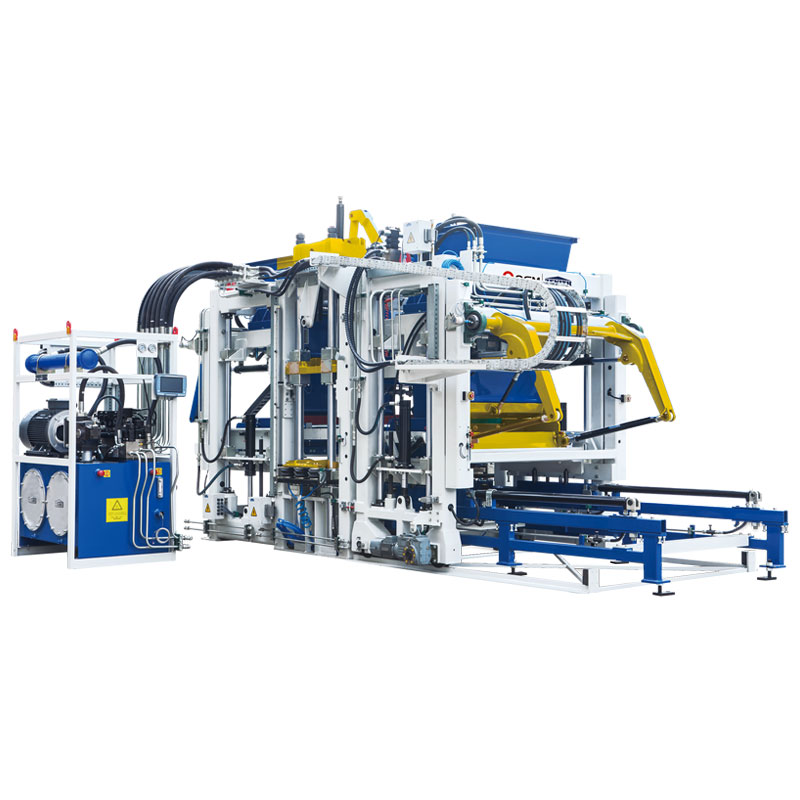
Production capacity is the foundation of your revenue. The QGM Block Making Machine ZN1500-2C model delivers a cycle time of 12 to 15 seconds for standard 400x200x200 mm hollow blocks. In an 8-hour shift, this translates to a theoretical capacity of 1,920 to 2,400 blocks. However, real-world output accounts for material loading, pallet changes, and minor adjustments. In our factory, we have tracked production data from 15 plants across Southeast Asia, and the average realized output is 1,850 to 2,100 blocks per shift. This means a single QGM Block Making Machine can produce between 37,000 and 42,000 blocks per week on a double-shift schedule.
The table below compares this with other machines in the same price range.
| Machine model | Cycle time (seconds) | Blocks per 8-hour shift (realized) | Weekly output (2 shifts, 6 days) | Annual output (50 weeks) |
| QGM ZN1500-2C | 12 – 15 | 1,850 – 2,100 | 37,000 – 42,000 | 3.7 – 4.2 million |
| Semi-auto machine (competitor) | 25 – 35 | 900 – 1,200 | 18,000 – 24,000 | 1.8 – 2.4 million |
| Manual machine | 45 – 60 | 450 – 600 | 9,000 – 12,000 | 0.9 – 1.2 million |
If you are selling hollow blocks at $1.20 per block, the QGM Block Making Machine can generate $2,200 to $2,500 in daily revenue on a single shift. On a double-shift schedule, that is $4,400 to $5,000 per day. For a small to medium block business, this is the scale that transforms a side business into a full-time enterprise. At Quangong Machinery Co., Ltd., we provide production verification as part of our installation process. Our technicians run a full shift with your materials and confirm the output before handover.
2. How Quickly Can a QGM Block Making Machine Pay for Itself?
The payback period is the number one question we receive from business owners. The calculation is straightforward: divide the total investment by the monthly net profit generated by the machine. A QGM Block Making Machine ZN1500-2C with full automation costs between $25,000 and $35,000 depending on the configuration and shipping. After installation, you have three cost categories: raw materials (cement, aggregate, sand), labor, and electricity. The table below shows a typical monthly operating cost and revenue for a plant using a QGM Block Making Machine in a developing market scenario.
| Item | Monthly amount (USD) | Notes |
| Revenue | ||
| Blocks sold (2 shifts, 6 days, 38,000 blocks/month) | 45,600 | At $1.20 per block |
| Operating costs | ||
| Raw materials | 22,800 | 50% of revenue (typical for this product) |
| Labor (3 operators per shift, 2 shifts) | 4,800 | At $800 per operator per month |
| Electricity | 1,800 | At $0.12/kWh, running 16 hours/day |
| Maintenance & consumables | 600 | Lubrication, wear parts, etc. |
| Net monthly profit | 15,600 | After all operating costs |
At a net profit of $15,600 per month, the payback period for a $30,000 QGM Block Making Machine is approximately 1.9 months. Even if you are operating on a single shift, the payback period is just under 4 months. In our factory, we have documented payback periods ranging from 3 to 8 months for our customers, depending on local material and labor costs. The QGM Block Making Machine pays for itself before the first set of molds wears out.
Key ROI number: A 2-month payback means that for the first 2 months, your machine is earning its keep. From month 3 onward, it is pure profit generation. Over 5 years, a QGM Block Making Machine can generate $900,000 to $1,200,000 in net profit for a double-shift operation.
3. How Does Automation Reduce Labor Costs Over Time?
The QGM Block Making Machine with full automation requires only 3 operators per shift: one for the control panel, one for material handling, and one for quality inspection. A semi-automatic machine requires 6 to 8 operators per shift. The difference is 3 to 5 fewer salaries per shift. Over two shifts, this is 6 to 10 fewer salaries per day. At an average operator wage of $800 per month, the QGM Block Making Machine saves $4,800 to $8,000 per month in labor costs. The machine pays for the automation upgrade within the first year of operation.
4. What Are the Hidden Costs That Make Other Machines More Expensive?
The purchase price is the most visible cost, but it is not the most significant one. A cheaper machine will cost you more in the long run in three ways. First, downtime: a semi-automatic machine breaks down on average once every 150 operating hours. A QGM Block Making Machine breaks down once every 800 operating hours on average, based on our factory's field service records. Each downtime event costs you a full shift of lost production. Second, energy consumption: the QGM Block Making Machine has a regenerative hydraulic system that reduces energy consumption by 34 percent compared to fixed-speed systems. Third, material waste: the precision molding reduces reject rates from 3 to 5 percent (typical for manual machines) to under 1 percent. This means you are not paying for materials that end up in the scrap pile.
Frequently Asked Questions About QGM Block Making Machine Investment
Summary for Block Business Owners
The QGM Block Making Machine is a profitable investment because it produces higher daily output, consumes less electricity, and requires fewer operators than competing machines. The payback period is under 4 months on a single shift and under 2 months on a double-shift schedule. The hidden cost savings in reduced downtime, lower material waste, and longer service life make it the most cost-effective option for growing block businesses.
Quangong Machinery Co., Ltd. has supplied QGM Block Making Machines to over 3,000 customers in more than 80 countries. We provide installation supervision, operator training, and ongoing technical support. Our factory offers a free ROI analysis for your specific location.